Showing posts with label Luther. Show all posts

Friday, August 1, 2014

Directions for Singing: Part 4 - Sing Lustily and with Courage

In John Wesley’s first two points we have seen what to sing. His third point has allowed us to touch a bit on why we sing and specifically why we should sing together. Now in these final four points Wesley directs us how to sing. To be honest, this is my favorite instruction. Years ago when I first came across these “Directions for Singing”, this is the one that stuck out. It lingers about my mind nearly every Sunday morning.

4. Sing lustily and with good courage. Beware of singing as if you were half dead, or half asleep; but lift up your voice with strength. Be no more afraid of your voice now, nor more ashamed of its being heard, than when you sung the songs of Satan.

A few posts back I mentioned an experience that contrasted with my normal expectations about congregational singing. After years of being formed by dreary, yawn inducing singing, I attended a congregation who taught me a lesson. We began with “Praise to the Lord the Almighty” and I thought the church would crumble like the walls of Jericho. The rumble, the boom, the power of that gathered voice, full of mirth and might, was almost overwhelming to my unaccustomed ears. It was this moment that gave me the clearest understanding of just how anemic my experiences up until then with congregational singing really had been. It was like being raised on rice and beans my whole life and then someone offered me a steak. These people were doing exactly what Wesley tells us to do; they were singing lustily and with good courage. And it made me want to join in.

Sing Lustily
What does it mean to sing lustily? Words like, vigorous, hearty, and mighty come to mind. There is oomph behind it. It’s warriors singing as they march to battle. It’s the National Anthem sung after a gold medal at the Olympics. It’s the seventh grade girl’s sleepover where hairbrushes are microphones.

Maybe the best way to think of it would be singing whole-heartedly. If we love the Lord our God with all of our heart and mind and strength then we should sing to the Lord our God with all our heart and mind and strength. That includes our voices. Which includes the volume of our voices. Which means your half-sigh-sing-along is less than whole-hearted. Which means your song is lacking in more than just volume. When you sing half-dead or half-asleep, or when you are ashamed of being heard, you are saying something to God and to the Church (and about them). You are saying that you are half-hearted. Which means the only thing you’re good for is to be spat out. Were that you hot or cold…

When I think of the epitome of whole-heartedness I think of my 7 year old son. When he sets his mind on something he doesn’t let it go. Ever. The kid is a pit bull. However noble (giving money to the church) or silly (playing a certain video game) he pursues his desire with every fiber of his being. His joy or misery hinges upon it. It’s his first thought when he wakes up and his last thought before his eyes close. Often it’s his whole-heartedness that gets him in trouble. The (fantastic) reason it gets him into trouble is because it gives him boldness. If he sets his mind on something he’s going to ask me to do it until I give in or punish him for asking for the 1000th time…or he’ll just do it without asking. He “knows” that he will get in trouble if he asks “one more time”, but in his whole-hearted boldness he risks it anyway. He’s still learning how to be obedient and how to have self-control, but his whole-heartedness is a good thing. But for most of us, whole-heartedness doesn’t come so easily. This is why we need courage.

And With Good Courage
Courage requires us to risk whole-heartedness. Courage tells us to act whole-hearted without being whole-hearted to begin with in the hope that acting whole-hearted will lead to whole-heartedness. That’s a chewy one. I explain it to my kids like this: You cannot be courageous without being afraid. Fear is necessary for bravery. You cannot have courage without it. If fear is absent from your action, then you are not being brave, you are being normal (or stupid). Courage is being afraid and doing it anyway. Every time my kids say, “I’m scared” it is an opportunity to teach courage. Courage never feels like courage to begin with. It feels like anxiety. You only feel courageous after the deed is done (maybe).

So singing with good courage doesn’t mean you have to feel like it before you sing. In fact, with our understanding of courage, it means the opposite! You don’t feel like singing? You’re exactly where you need to be. Now sing as if you are singing with your whole heart. You feel like a liar? Because you are. Keep singing. You feel your voice isn’t very pleasant sounding? At least you know it. Keep singing. Whatever fears and excuses (legitimate!) you have, sing through them. If Christ has conquered Satan and the gods of this world, if Christ has conquered sin and death, then whatever fears we have that prevent us from singing whole-heartedly when we gather to sing will pale in comparison. Christ gives us courage greater than the courage of the world because He has already conquered.
If God is for us, who can be against us? He who did not spare his own Son but gave him up for us all, how will he not also with him graciously give us all things? Who shall bring any charge against God's elect? It is God who justifies. Who is to condemn? Christ Jesus is the one who died—more than that, who was raised—who is at the right hand of God, who indeed is interceding for us. Who shall separate us from the love of Christ? Shall tribulation, or distress, or persecution, or famine, or nakedness, or danger, or sword? As it is written, “For your sake we are being killed all the day long; we are regarded as sheep to be slaughtered.” No, in all these things we are more than conquerors through him who loved us. For I am sure that neither death nor life, nor angels nor rulers, nor things present nor things to come, nor powers, nor height nor depth, nor anything else in all creation, will be able to separate us from the love of God in Christ Jesus our Lord.

So sing out!

Epilogue: A word to the men of the church
My eye is heavily upon you here. Growing up, those who actually did sing were the ladies. It was the men with folded arms and furrowed brows with their traps shut. That taught me another thing I had to unlearn later: Singing is for girls. Such an impact is not just harmful, it is evil. The force behind such thinking is satanic. Satan is dancing to your droning. He’s giggling like the schoolgirl he makes you think you’ll be if you sing out. Though the fiery dragon has been dealt a mortal wound by our great Savior, his death throes are still dangerous. He still has poison and the power to enchant you. But God has given you a weapon to break the spell and fight back. What are you doing with it? Yawning? Martin Luther said,
The devil, the originator of sorrowful anxieties and restless troubles, flees before the sound of music almost as much as before the Word of God…Music is a gift and grace of God, not an invention of men. Thus it drives out the devil and makes people cheerful.

Every Sunday when the church gathers in song, a sword is always held at someone’s throat; the devil’s or yours. Worship is war and your half-hearted singing is a position of pathetic weakness, a treacherous act. Your mumbled song is a whimper that only discourages your comrades and emboldens the enemy. Your children will see your defeat and follow you. What will their children do? Do you care? Paul encourages us to “be watchful, stand firm in the faith, act like men, be strong.” Singing is a way to guard and stand firm in the faith, so act like a man and sing with strength.

This Sunday sing with vigor and might. That means with oomph. Your guts are going to have to get involved. Intestinal fortitude two ways. If people notice then you’re probably doing it right. You’re not going to feel like it, but that’s where courage kicks in. Sing out and sing through. 

============
Previous installments of the Direction's for Singing series

Friday, May 15, 2009

Martin Luther's Warning

Before I choose a song for the congregation to sing on a Sunday, I make it a priority to read exactly what will be sung beforehand. The content of a song, the lyrics—that truth that is contained within the boundaries of melody—is the most important aspect of the song itself.

Perhaps Martin Luther understood this better than anyone. During the Reformation, the most popular way doctrine spread was not through the intellectual discourses between the theological heavyweights, but through hymns! And specifically hymns in the language of the people.

Martin Luther recognized the power and effectiveness of these songs, and in fact, he went on to write many hymns to teach and edify the church, but he also knew the dangers that would threaten to enter the church through song. Which is why he wrote these words:

False masters now abound, who songs indite;
Beware of them, and learn to judge them right:
Where God builds up his Church and Word, hard by
Satan is found with murder and a lie.

False teachers don't always enter the church as Pastors or Sunday School teachers, but also as hymn/worship music writers, and music ministers. It is a sobering thought to be given the responsibility to discern what is right and wrong for a congregation to sing. To those who are in such a position I hope Luther's words of warning impact you in the way they have impacted me. My prayer for myself and for those in a similar position is that God would grant His grace that we may continually be able to "judge them right."

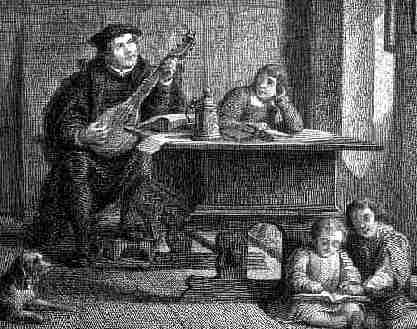
By the way, I love that picture of Luther because it reminds me of myself...sitting at the table with my instrument, a drink on the table, papers scattered, children playing in the room, dog on the floor...that table even looks like mine.

Wednesday, April 8, 2009

From (and For) the Mouths of Babes

A few Sunday’s back I led the congregation in the songs “A Mighty Fortress is Our God” by Martin Luther and “I Sing the Mighty Power of God” by Isaac Watts. The primary reason I chose these songs is a bit obvious by their titles; the Mightiness of God. Not only do the lyrics express the Mightiness of God, but the music enhances that idea with their majestic yet militaristic tunes. But as I was driving home from Springfield the night before, reflecting on the songs that would be sung the following morning, I felt I needed to explain the meaning of the words ‘bulwark’ and ‘Sabaoth’. After all, the song is almost 500 years old. But then I remembered who the intended audience was for both of these songs; children. I was struck by the thought so much so that I mentioned it Sunday morning and on a rather off-handed remark I asked that if these songs are the ‘high water-mark’ in congregational singing today and yet they were originally intended for children, what does that say about us today? I am still pondering that question and I am not exactly sure if my conclusions are solid. When I ask “what does that say about us today,” I believe it leaves us with a couple of challenges.

First, how do these songs compare to our children’s songs today? I don’t want to criticize the intention of those who compose our modern day children’s songs because I believe that many are very instructive in their simplicity for the very young. But unfortunately most children’s songs for today are only appropriate for ages 0-4. Such as “The B-I-B-L-E” and “Zacchaeus Was a Wee Little Man”. They fall in line with other nursery songs such as “The Ittsy Bittsy Spider”. The resources today for children’s music are a little better than wretched. The CD’s you find at your local Christian bookstore are horrendous. First you have the nice lady who probably taught kindergarten singing all her songs in a goofy baby-talk voice. This works for babies and dead people. Second you have the lullaby edition that contains dreamy, sleepwalky, instrumental hymns that only adults (who grew up in the church) know. The only purpose for these are to soothe your baby to sleep. And last but not least it is the top 25 “hot” worship songs from CCLI sung by 12 over-enthusiastic kids. Let’s just say that if this album came with two CDs, you now have an extra Frisbee in case the first CD goes into the neighbors’ yard. Obviously, there is a glaring hole in the quality of children’s music in the church today. Why do we have to dumb down our children’s music? Children learn at an incredible rate. They are sponges that soak up everything around them. If they are exposed early on to the truth then they can only grow from there. I’m not saying we need to get rid of all our modern children’s music, but let’s expand it, and improve it vastly! How would the church look today if the past generation of children grew up on songs like “A Mighty Fortress is Our God” rather than nursery songs until they entered youth group?

The next thing I notice is that though these hymns began as songs meant for children, they stood the test of time by matching beautiful truth with beautiful music. Obviously, ours is not the first generation to use these songs for congregational singing. They have been sung for hundreds of years. What that means for us (the church) is that we (the church, not the music industry) should be striving to produce similar music. Not similar in sound or style, but similar in substance and quality, musically and lyrically. Sometimes I wonder if the “worship” music industry is more of a curse than it is a blessing. If the blessing is the abundance of resources then the curse is that most of the resources are just pumped out for cash with little consideration for the local church. The reason I bring up the “worship” music industry is because there is such a stark contrast in the production of “modern worship” songs compared to the songs produced by Luther and Watts. Why did Luther and Watts produce these songs? Because they cared for the children in their congregations enough to instruct them in the truth. Why does the “worship” music industry produce new music? Yikes. That one is harder to answer because it not very clear that the local congregation is who they are writing for. I don’t think Isaac Watts would be comfortable referring to himself as a ‘worship artist’ and I have a hard time imagining Martin Luther being interviewed by CCM magazine and saying something like, “I was just sitting there with my lute and God just gave me this song. It was, like, the Spirit was totally there.” Get my point? These guys wrote for the church. They didn’t make an album and sell it. They didn’t go on tour to promote their songs. They saw a need and filled it and God blessed it. I wonder what would happen if poets and musicians invested themselves in theology and the local church? Or if theologians and pastors would take time to write some poetry? What if they teamed up to produce music for their local congregation, not to sell a CD, or to make a name for themselves, but to serve the church?

Side Note: I am not saying that a pursuit in the “worship” music industry is bad. But what I am saying is that it is very different to how the church has historically found her voice musically. It is hard for me to believe that the “worship” industry, modeled around popular music’s industry, is in the business of serving the church. Now, if we are talking about artists and musicians who are Christians creating music and art based upon Christ I have no problem with that! God is glorified through that vocation. The problem starts when the (usually highly subjective) art or music is mistaken for congregational worship songs. I know that every now and then, one slips through the cracks and winds up being a great congregational worship song, but in the end the “worship” industry is out to make money (and there’s nothing wrong with that in and of itself) and serving the church is secondary, if it is even a goal at all.

[In the future I’ll be posting more about the difference between today’s Christian songs, like the ones heard on the radio, and Congregational songs]

Thursday, March 12, 2009

Music is a Servant to Words

As I was flipping through my new copy of Gadsby's Hymns the other day I kept thinking about a statement made by Bob Kauflin, "In congregational worship, music is a servant to words." This simple statement has almost become a philosophy for me. Not only does it direct our attention to the most important aspect of congregational singing (the words/lyrics and the truth contained in them) but it gives the music, which accompanies the lyrics, a higher purpose than just being a "catchy" tune.

What I'm getting at here is basically this; a song, no matter how theologically rich and wonderful the words may be, must have an appropriate tune to carry it. I like to think of it this way; music is the vessel, or cup, that carries the lyrics, which is the liquid contained. Now you can drink wine from a styrofoam cup, but a more appropriate vessel is a wine glass. The glass was specifically made to complement the wine. I feel like a lot of the older hymns have suffered because of this. So many great lyrics have been paired with trivial, boring, or just plain wretched melodies it is no wonder why many people cringe when they hear the word 'hymn'. Wine in any old cup is still wine, but it cannot be fully appreciated and fully enjoyed if not contained in the proper vessel, namely a wine glass.

The flip side of this idea is no matter how beautiful, majestic, catchy, or pleasing the music may be, it means nothing if the lyrics are simply weak theology and mindless dribble. To continue the analogy, if you owned a beautiful ornate goblet, fit for a king, would you drink chocolate milk, or kool-aid out of it? If you are 10 then yes, you would. But for anyone else it doesn't make since to do so. The reason is because kool-aid, though sweet and tasty, is not complemented by such a cup. The reason I don't drink kool-aid from a wine glass is the same reason I don't drink wine from my child's sippy cup.

Here are a few practical examples. Let's look at the most well loved English hymn, Amazing Grace. The words were written by John Newton in the 1700's but the tune, NEW BRITAIN, was written in the mid-1800's. Before the tune was composed Amazing Grace was just another ordinary song in the hymnal. Nothing special really, other than good poetry. Now, take the words to Amazing Grace and sing them to the tune of Gilligan's Isle or House of the Rising Sun. Some people would say that is sacrilege! That is because the tune falls short of the lyrics. They do not complement each other. It is wine in the sippy cup.

Here's another, albeit a bit silly. The tune and lyrics of A Mighty Fortress is Our God written by Martin Luther evoke majesty and triumph. Let's use that wonderful tune to sing the following lyrics:

There was this man from Galilee/His love is like a river/He died one day upon a tree/He is the perfect giver/I raise my holy hands/and bow and kneel and stand/Just gotta worship Him/And singing without end/La la la la la la la la la. (with hand motions?)

Ok, first I must say that I feel dumb just writing that off the top of my head. I need to apologize to Martin Luther when I get to heaven. Second, these lyrics (unfortunately) evoke much of today's modern "worship" music, however I digress, that is for another post... But it serves to make my point clear. This is kool-aid in the wine glass.

This may not seem like a very important topic to some people but for the singing congregation I believe it is vital. Trivial music paired with truth-laden lyrics will cause us to trivialize the truth. Wonderful, beautiful music paired with weak, senseless lyrics will cause us to believe that what we are singing is the core of the gospel, when in fact we may be happily singing heresy!

So let us be cautious in what we sing by understanding the submissive role music takes to the lyrics.