Showing posts with label music minister. Show all posts

Friday, September 23, 2011

Wanted: Hymn Writers

The church is always in need of more hymns. Good hymns. Hymns that last the test of time. Hymns busting at the seams with biblical truth matched with mind blowing beauty. Hymns full of sound doxology. A robust collection of hymns that give voice to every occasion.

One thing the church does not need more of is bad hymns. Shallow hymns. Ugly hymns. Meaningless hymns. Unfortunately it is much easier to write wretchedly than it is to write wonderfully.

So what the church needs (and always needs) is an army of hymn writers. Hymn writers who value truth and beauty. Hymn writers that venture into the depths of the riches of the wisdom and the knowledge of God and come back with treasures and tales of their adventures in that marvelous, perilous realm. What a noble task it is for the church to equip their poet-warriors with the necessary tools and training for such a calling.

Unfortunately, the church in America has done a pretty pitiful job at raising up hymn writers. I mean, if the church struggles to raise up pastors, how on earth will they be able to raise up hymn writers? I'm not talking about training and equipping musicians, though I believe that is a worthy goal I also believe that the church has more musicians than she knows what to do with. Heaven knows we could certainly deal with one less rock star wannabe. Then again, Heaven knows we could certainly benefit from fresh new melodies packed with submissive beauty.

But hymn writers need to be more than musicians. I would even say it is possible that one does not necessarily even need to be musically talented to be a good hymn writer. Though musicality is beneficial, I would argue that hymn writers need to be poetical rather than musical (though some would argue they are one in the same to some degree). But the point is that a hymn writer doesn't need to play piano or guitar or even sing well to write a good hymn.

Not only does one need to be poetical, but also vastly knowledgeable about God. This means that an understanding of sound theology and doctrine is crucial for the hymn writer. It is no surprise to me to see that almost every master hymn writer in the past was a pastor. Wesley, Watts, Newton, Doddridge, etc. Their main business was mining the depths of the gospel each week. To do so they had to be intimate with the Scriptures. As a result, not only were these men pastors worthy of emulation, they became the greatest hymn writers of the English language. Where are our pastor-hymn writers of today? There are exceptions to this however, in that there are many great hymn writers who were laymen. Anne Steele and William Cowper, for example. But only skim through their hymns and you will find that they are dripping with theology like honey from the comb.

The key is that a hymn writer needs to strive to become masterful in joining together truth with beauty. (A love for the people of God, I believe is quite necessary as well.) I like how Kevin Twit describes this melding of truth and beauty in hymns: "theology on fire". And it's in the church's best intrest to invest time, energy, and resources into developing and assisting her hymn writers.

Most of these thoughts were fueled by the following three articles. I happened to read them all within about a day of each other and I became greatly encouraged how each one seeks to support the hymn writer.

Here’s a portion of what he says:
"Let this be an encouragement to modern hymn writers—a cause for inspiration to those who are suffering from writer’s block. There are so many Biblical scenes to choose from that would make for beautiful songs: the transfiguration of Christ, the feeding of the five thousand, the woman at the well, the stoning of Stephen, water baptism, washing of the disciple’s feet, the betrayal of Judas. If just a few good modern hymn writers tackled some of these subjects, the anguish that untold thousands of music ministers suffer weekly could be greatly diminished.

It’s easy to write a chorus that says:
God, you are a Holy God
I need your grace to see me through
I need your mercy to make me new
Let me live each day for you.

I just made that up in two minutes and there’s nothing wrong with it. It might fit easily and competitively among the hundreds of worship songs that are available to choose from. But compare those lines to the third stanza from the above hymn:

Let holy charity mine outward vesture be,
And lowliness become mine inner clothing;
True lowliness of heart, which takes the humbler part,
And o’er its own shortcomings weeps with loathing.

It took some real thought to craft those lines. They’re timeless. They set a standard for all of us who write music for the church. I didn’t set out to write a didactic piece. I’m reminding myself, too. Be specific when you write songs about God. Avoid cliché. Avoid convenience. Avoid an obsession with the consumer. Avoid the temptation to make commercial success your central goal. Write with intelligence, employing all the craft, skill, and experience with which God has endowed you."
I absolutely love what he has to say. Though this kind of thing has been said before, it can never be said enough. Encouragement and advice like this needs to become as strong and steady as a pounding drum.

  • The second article that caught my eye is over at Cardiphonia. Bruce Benedict has been kind enough to share what he's been learning in his "Songwriting and Theology" class at Duke. I hope he takes good notes because I'm stealing them...
Songwriting and Theology
Songwriting and Theology Week 2 Paradoxes 

These posts are great in and of themselves and Bruce links to some great thought provoking articles, but what really grabbed my attention was something his teacher said:
"The Church has no theological expectations of her musicians."
This such a sad statement that at first I had a hard time agreeing with it. But after thinking about it and pondering the putrid wasteland of music that has been produced (and peddled, and packaged, and sold)  by the American Church, I have to agree for the most part. It is certainly true that this is an accurate reflection of the status quo.

I would also take that expression and turn it on it's head a bit and say that, "The Church has no poetical or musical expectations of her pastors and theologians."

  • Third, I came across this new blog by Sojourn Music songwriters Bobby and Kristen Gilles called My Song in the Night. It looks as if this entire blog will be highly beneficial the hymn writer.
The 'mission statement' of the blog says this:
"Helping you express words of worship and testimony through songs and stories."
The article I specifically want to direct your attention to is one in their Songwriting section called Modern Hymns. They do an excellent job at laying out a very basic outline of the ins and outs of hymn writing. Just reading through this made me want to stop and find a pen and paper.


  • Lastly, though I didn't just run across this, I do want to direct your attention to a post I put up a few years back called Towards a Better Hymnody. I link to a pamphlet that I think will continue to help us think soundly about our hymnody and our hymn writers. Also, as it was written more than 50 years ago, it lends to the idea that the church is always looking for better hymns and hymn writers.

I hope that these articles have motivated you like they have me. Let's keep the drum pounding. Let's keep spreading the word that the church is in great need of hymn writers.

Friday, July 30, 2010

KC Worship Conference with Dr. Don Whitney and Ron Owens


I am really excited for this upcoming conference on Biblical Worship that is being hosted at my church in August. Don Whitney (who is pretty much the man) will be our main speaker alongside Ron Owens. It's an all day event that includes a BBQ dinner and there is no cost!

Dr. Don Whitney is the Associate Professor of Biblical Spirituality at The Southern Baptist Theological Seminary in Louisville, Kentucky and is the author of Spiritual Disciplines for the Christian Life. Back when Don was a professor at Midwestern here in Kansas City I was privileged to be present on a couple occasions when he taught and preached at a local church. His lessons on Spiritual Disciplines has had a lasting impression on me (especially actually resting on the Sabbath) and I often go to his website for his articles and advice on worship.

Ron Owens has worked alongside Henry Blackaby in worship ministry for many years and is the author of the book Return to Worship: A God Centered Approach. I ran across this excellent book about 10 years ago. It was a very key book early in my ministry that struck a pretty severe blow to my faulty understanding of worship. I am thankful to God that I read this book at a relatively young age (around 17 or 18) and I can definitely look back at that time period as a pivot point in much of my theology of worship and Ron's book played a large part in that. His website is here.


Not only will these men be in town for the Worship Conference but they will also be here for an ordination service for three men, including myself. Dr. Don Whitney will be preaching and Ron Owens will be leading worship. I am humbled at God's grace and gifts and am greatly anticipating that day.

If you live in driving distance to the KC area this is conference is definitely a must. If you live a little further out and need to stay overnight, contact our church (info below) and we'll point you to some good hotels or whatever you need. You will simply not find another Worship Conference in the Midwest of this quality for free.

Further Information about the Worship Conference:

WorshipKC10- Not for Wimps

A major conference on Biblical Worship will be held Saturday August 14 from 2 to 9 PM at Wornall Road Baptist Church. Our two featured leaders will be Dr. Don Whitney of Southern Seminary and Ron Owens, who for many years was the ministry associate to Henry Blackaby.

WorshipKC10 is an ideal conference for pastors, worship leaders and their ministry teams, and will benefit anyone who desires to learn more about Biblical Worship.

We are passionate about worship and helping others learn about worship so there is no cost for this event and a BBQ dinner with our two speakers is included. The conference and the dinner are free so come hungry for the Word and hungry for some excellent KC BBQ!

Please respond via Facebook or contact the church office at 816.444.8900 or wornallroad@gmail.com so we can have a headcount for dinner. And be sure to check out http://www.wornallroad.org/ for more info!

And be sure to stay tuned, I'll be posting the upcoming Schedule for the conference soon!

Tuesday, July 6, 2010

"Give 'Em Watts, Boys!"

“The Battle of Springfield” - June 23rd, 1780
Six-thousand British troops invaded New Jersey with full force. The opposing American forces were outnumbered 5 to 1. The British slowly pushed the Americans back, deeper into Springfield, New Jersey. Despite being pushed back the American defense was holding and the British were taking a beating. But during the battle the American troops ran out of wading for their muskets. This would have likely been their downfall had it not been for the quick thinking of Rev. James Caldwell. Caldwell and his men fell back to a Presbyterian church and Caldwell ran inside gathering all the hymnals he could find—which were at that time Isaac Watts’ editions—and began flinging them to the men, yelling as he did so, “Give ‘em Watts, boys! Put Watts into ‘em!” and instructing them to “fill the British with doctrine from the hymnals.” The battle waged on and the British eventually retreated and never invaded New Jersey again.

"Give 'Em Watts, Boys!"
Two things pop out at me when I read that story. The first is that it is such a good story it is almost unbelievable. It seems like it comes directly from a Hollywood script. But the story is true and very well documented. In fact the phrase “Give ‘em Watts, boys!” has lived on as a motto in that region.

The second thing that hits me is how that motto could (and should) be used today in the church. I want to revitalize it and give it new meaning. I want to use it as a new battle cry, but this time instead of using it to inspire men to pump Red Coats full of lead I want it to inspire men to use and continue using the great hymns of our faith. I have yet to encounter any songwriter or lyricist who can capture the gospel in poetic English the way in which Watts, Wesley, Newton and other hymn writing giants have done. This is not to say that we should only sing Watts and those like him (though we would hardly be at a disadvantage if we did), but rather we should not abandon the songs and hymns these men have given to us. I am all for writing new music and new words. Every generation should do it! But I am not for discarding that which has come before us, as is the unfortunate habit (or is it philosophy?) of many churches. I am convinced that a church’s theology is more likely determined by the songs they sing rather than their written statement of faith. And at a time when many churches are considered trite or flippant or even weak, a little Watts could serve as a shot in the arm, maybe even a catalyst for change.


If I had a group of worship leaders, pastors or any manner of church leaders before me, I would encourage them to either bring back or continue steadfastly using the old hymns for their congregations. I would bark at them like a General, “Load ‘em up with Wesley!” “Put Newton into ‘em!” “Give ‘em Watts, Boys! Give ‘em Watts!”

Wednesday, April 21, 2010

Worship Leaders: Imitate William Gadsby and Charles Spurgeon

"Remember your leaders, those who spoke to you the word of God. Consider the outcome of their way of life, and imitate their faith." -Hebrews 13:7

In the time span of over 50 years two hymnbooks were published in the 19th century. William Gadsby published his hymnbook, now known as Gadsby’s Hymns, in 1814 (and later in 1838) and Charles Spurgeon published his hymnbook, known as Our Own Hymn-book, in 1866. Both men compiled these hymnbooks in a very comparable fashion and I think it is worth our time to find out why and imitate their example.

While both men have many admirable qualities that would be beneficial for Christians to study and emulate, I want to focus on the strikingly similar pastoral concern that both men had for their congregations concerning the worship of God through singing. From reading the preface of each hymnbook we discover the reasons why Gadsby and Spurgeon made the effort to compile their hymnbooks in the first place. I want to take a look at what reasons both of these men gave in their own words and see how we might benefit as worship leaders by imitating these two great men of faith.

Gadsby’s Reasons

When Gadsby became the pastor of his church they had already been established in singing hymns from Watts, Hart, and from Rippon’s Selection. He writes, “Though some of these hymns are big with the important truths of God, there are others…which give as legal a sound as if they had been forged at a certain foundry. This was one reason which induced me to publish a selection. Another was, we had three editions of Hart’s Hymns amongst us, either differently arranged or differently paged; so that when any of those hymns were given out, one part of the congregation was unable to find them. These circumstances, together with a desire in my own breast and the express wish of others to have a selection of hymns in one book free from Arminianism, and sound in the faith, that the church might be edified and God glorified, were what induced me to attempt this work.”
(For Gadsby's Preface click here)


Spurgeon’s Reasons

Spurgeon wrote a bit more about why he felt it necessary to compile a hymnbook but we can gather his primary motives through the following excerpts:

“Our congregation has long used two hymn-books [Watts and Rippon]…and we should most probably have been very well content with those books had it not been for difficulties connected with the remarkably complex arrangement of their content. To strangers it was no small task to discover the hymn selected for singing; for, in the first place, there were two books, which was in itself an evil; but the matter was made far worse by the fact that these two volumes were each a puzzle to the uninstructed…We felt that such ought not to be the state of our service of song.”

“None of the collections already published are exactly what our congregation needs, or we would have cheerfully adopted one of them…Our congregation has distinctive features which are not suited to every compilation, not indeed by any known to us.”

“Subjects frequently passed over or pushed into a corner are here made conspicuously the themes of song; such, for instance, as the great doctrines of sovereign grace, the personal Advent of our Lord, and especially the sweetness of present communion with Him.”
(For Spurgeon’s Preface click here)

Concern for Order, Unity and Intelligibility

Both men laud the efforts of the likes of Dr. Watts’ and Dr. Rippon’s collections but they understood that the way in which their congregations used these wonderful resources hindered worship greatly. The collections were contained in multiple volumes and editions which lead to endless page-flipping and book switching after every song. Various editions of the same hymnbook would produce confusion as to which hymn number the congregation was going to be singing and certain verses might be laid out in a different order or omitted altogether.

The lack of a uniform means of presenting songs no doubt led to an improperly ordered service. The lack of participation due to these reasons led to disunity. Both of which led to unintelligibility of praises. Spurgeon writes, “The providence of God brings very many new hearers within the walls of our place of worship, and many a time we have marked their futile researches, and pitied the looks of despair with which they have given up all hope of finding the hymns, and so of joining intelligently in our words of praise.”

These men saw a problem and out of their concern for congregational order, unity and intelligibility they produced a hymnbook which accomplished all three. Not only did this solution edify the church, but it also broke down unnecessary barriers to unbelievers who might visit.

Concern for Sound Doctrine

It is apparent that both men had a deep concern for their congregations to have a steady diet of sound doctrine in their hymns. Gadsby introduces his hymnbook with Psalm 47:7 “sing ye praises with understanding.” Both men were aware of the educational impact of hymns and sought to squelch shoddy theology and emphasize that which is good. Spurgeon made it a priority to not only include doctrinal songs but to highlight them and push them to the forefront of congregational singing. Gadsby, a true Strict Baptist of his time and a man of stronger backbone than most today, found it necessary to not only emphasize sound doctrine, but to make sure his collection was devoid of Arminian theology. Here both men are truly acting like Shepherds for their congregation; guarding, tending and feeding all at the same time.

Concern for Their Flock
Ultimately these men cared greatly and deeply for their congregations. They wanted to see the praises of God sung orderly, with unity and intelligibility, through sound doctrine “that the church might be edified and God glorified.” And while I am sure that these men loved the Church universal, it is abundantly apparent that they loved their local congregations very, very deeply. The hymnbooks that they produced for their churches are landmarks of this love. That Spurgeon’s compilation became known as Our Own Hymn-book is evidence enough that the local church was the primary focus of the project.

Gadsby and Spurgeon knew their congregations intimately enough to recognize that they couldn’t just copy or mimic another congregation. They needed to produce something specifically for their people. Spurgeon recognized that his congregation’s “distinctive features [were] not suited to every compilation.” Gadsby gave ear to the “express wish of others” concerning content for the hymnal.

Another indication of the love and concern these men had for their flock is the fact that they composed hymns for them. Gadsby composed and included over 150 hymns in his compilation. Spurgeon composed several himself and tells us why. “The editor [Spurgeon] has inserted with great diffidence a very few of his own composition, chiefly among the Psalms, and his only apology for so doing is the fact that of certain difficult Psalms he could find no version at all fitted for singing, and was therefore driven to turn them into verse himself.” Spurgeon knew what his congregation needed and he supplied it, however hesitantly, out of love.

An additional point we should consider is the way in which both men seem to be plainly aware of Christian Pop-culture’s influence on their congregational music. In deciding how to shape his hymnbook Charles Spurgeon writes,
“We have not cast about for models suggesting by the transient fancy of the hour, but we have followed the indications given us in the word of God and the long established usage of the universal church; desiring to be obedient to the sacred precept, “Let the word of Christ dwell in you richly in all wisdom: teaching and admonishing one another in psalms and hymns and spiritual songs, singing with grace in your hearts to the Lord.”
And Gadsby takes aim at Watts and Rippon’s work, saying that some of their hymns “give as legal a sound as if they had been forged at a certain foundry.” The imagery he offers is that these popular songs, which are gospel-less, are being pumped out of the same mold (sound familiar?). Neither Spurgeon nor Gadsby attempted to copy Christian pop-culture but instead “followed the indications given us in the word of God.” And this was done out of a love for their church.

What This Means for Us

There is much we can learn from William Gadsby and Charles Spurgeon and their compilation of hymns for their congregations. Though we could spend hours discussing ways in which we could imitate these men (and I hope this does spur more discussion!), I want to look at three concerns they had that we would be wise to imitate in our ministries.
1) Imitate their concern for order, unity and intelligibility in worship. What is it that hinders any of these aspects as it relates to your congregational worship service? What are you going to do to remove those hindrances? Is it a visual issue? A sound system issue? A leadership issue? Whatever the case, I encourage you to read through 1 Corinthians 14 and prayerfully consider those things that hinder orderly, united, intelligible worship.

2) Imitate their concern for sound doctrine. Don’t just throw in a song every now and then because it has a lot of doctrine. I encourage you to make doctrinal songs a priority in your congregational singing! Emphasize theology! The more you know about God the more you will love God! Spurgeon puts it this way, “Oh, if you knew Him better, you would fly to Him!” Ask God which aspects of the worship service have overlooked or shoved specific doctrine into the corner.

3) Imitate their concern for the local church. The motive of all of this reforming was a deep love for the church. Both men wanted their hymnals to be of service to their local churches specifically. Any blessings that the hymnbooks might have outside of their local congregations were simply afterthoughts. Do you love your church enough to attend to their needs, guided by Scripture or are you trying to shoe-horn in the latest popular worship fad? Are you depending solely on a Worship Industry to direct your worship planning or do you have one ear to Scripture and the other to the congregation? Pray that God would increase your love for your local church. Ask God to reveal to you the “distinctive features” of your congregation and then seek to find the best and most biblical way to serve them.

I mentioned before, these men like Shepherds did their best to guard, tend and feed their flocks. The hymnbooks they produced sought to accomplish just that. This is the duty of all those who lead and minister the congregation. As a worship leader you have the privilege and responsibility to care for your people when selecting and leading songs and when you plan (in whatever capacity) the worship service. Take time to meditate on passages such as John 21:15-19, and the books 1 & 2 Timothy and Titus. Imitate great men of faith like William Gadsby and Charles Spurgeon and shepherd the flock with similar concern.

Learn More:
Purchase a copy of Gadsby's Hymns and Our Own Hymn-book from Grace and Truth Books
More info as well as some sermons and letters from William Gadsby
Tons of great info and more about Spurgeon can be found at The Spurgeon Archive
Also, I highly recommend checking out Red Mountain Music. They have done an excellent job of re-tuning a few of Gadsby's Hymns.

Tuesday, April 13, 2010

The Effeminate Worship Leader

A Note Before We Begin
Let me start by addressing a very sensitive related topic. I know that churches approach the subject of female leadership differently. Some find it acceptable to allow women to lead in every area of leadership in the church while others don’t even allow women to speak. The Bible is clear that men and women are valued by Christ equally (Gal. 3:28), they are spiritually equal, yet God in His sovereignty designed the roles of man and woman to reflect Christ and the Church (Eph. 5:24). God designed men and women differently so that they would find joy and a since of fulfillment in their particular role (Gen. 2:18). That said, a church that believes the biblical model of the roles of men and women will be shepherded only by men (1 Tim. 3:1-5).

On the same hand, we should also note that churches approach the position of worship leader differently. Some regard the position as a pastoral/elder led position while some regard it as simply a good singer leading songs to help the congregation. Depending on the church’s approach on the worship leader position a church might find it acceptable for a woman to lead worship. So with that out of the way, when I speak of The Effeminate Worship Leader, I am speaking about male worship leaders.

The Effeminate Worship Leader
There’s no real easy way to put it. I could beat around the bush and sugar coat it a bit, but in the end it would probably come off as more offensive than necessary. I’ll try to look at all sides to squash unnecessary offense so that the offense that will inevitably come might be helpful rather than harmful. But I want to address something that I’ve noticed and I am sure many others have observed and that is the Effeminate Worship Leader.

You’ve seen him. You know who I’m talking about. A little too sensitive, overly-emotional, flamboyant is a term that comes to mind. Usually it is seen as just an “artsy” thing. For some reason—and I just can’t put my finger on why—these guys are everywhere in Evangelical Christianity. I know I’m not completely off base because it has unfortunately become a stereotype. But I’m not just basing this off of stereotypes; I’ve noticed it many times personally and have had conversations with others who have noticed it as well. In some circles it has become a kind of in-house joke that the worship leader is metrosexual. And a metrosexual, if you are unfamiliar with the term, is basically a dude that acts like a chick (ie. effeminate). To make my point here’s a link to a humorous Christian satire site that provides a scorecard so you can rate how metrosexual your worship leader is. (I scored a 4 out of a hundred some points by the way…)

I know this isn’t a politically correct topic, but to me, it is a serious one. We can laugh it off with a wink, wink and giggle about it behind closed doors but there comes a time when leaders need to have their feelings hurt and be told to act like a man for the good of the church, the good of the gospel, and for the glory of God.

The War on Masculinity
Our culture is inundated with the lie that there is no difference between male and female. Everything is rapidly becoming gender-neutral. Actually it is more than being gender-neutral; plain and simple our culture is striving to become genderless. And one of the best ways to become genderless is to remove the very trait that has the courage to fight against it, masculinity. Boys are expected to act like girls at school, and when they don’t they get medicine shoved down their throats until they do. Homosexuality is glorified through media, academia, and legislation while any voice of resistance is slandered as hatred, intolerant, backwards and stupid. Feminism has practically stated that their goal is the eradication of masculinity. I could go on but the reality of our culture’s genderless agenda is all around us.

The Lack of Masculinity
On top of the bombardment of masculinity through genderlessness, it is also important for leaders to note the lack of masculinity in our society. Not only is fatherlessness a major problem in our society, but it isn’t even a stretch of the imagination to think how a child can grow up and never have any meaningful connection with a man. It’s easy to picture a child raised only by his mother, who goes to school taught by only female teachers, and perhaps gets a job where the boss is a woman. What’s wrong with that picture isn’t the amount of feminine influence; it is the lack of masculine influence, and that’s the ever increasing direction of our society. The lack of masculinity only fuels the fire for the war against masculinity.

What's the Big Deal?
So what does our society see differently when they go to church? I’m afraid in many cases they see only a mirror of the same effeminate culture. There is a time and a place to discuss the lack of masculinity in the church as a whole, and many helpful books and articles have been written to address this problem but I have never found one which focuses on worship leaders in particular. Though in snippets it has been discussed elsewhere perhaps I might be allowed a bit more liberty since I am a worship leader (and I have long hair too…).

I don’t know if I can put my finger on the exact reason why there are so many effeminate worship leaders. No doubt our society has played a part in producing men who think it’s cool or hip to be womanly, especially when it involves music. It is not uncommon for male musicians to wear eyeliner or paint their fingernails. People think of artists as having strictly feminine characteristics. They are viewed as sensitive, emotional, moody, frail, weak, and soft. In fact, this argument has been presented to me as an excuse for an effeminate worship leader. “Oh, I wouldn’t worry about it, that’s just how artists are.” Perhaps that’s how artists are expected to act in the world, but not in the church. However, if your worship leader is simply an artist and nothing more then, effeminate qualities aside, you need a new worship leader.

But should effeminacy in worship leadership really be addressed as a problem? Is it more than a pet peeve? Does it actually covey something to those who are being led? The answer to all is yes. If effeminate leadership reinforces a culture which opposes the gospel, then it is more than a pet peeve, it is a problem.

The songs that are sung, how they are sung, the clothes that are worn, and the manner in which one carries himself—whether in front of the congregation or not—all communicate something to those who are being led. And for those of us who are ministers of the gospel we not only represent ourselves and our church, but Christ whom we preach (or sing about). And if we lay aside our masculinity, the world notices nodding in agreement, the devil breathes a sigh of relief, and Christ is put to shame.

Don’t get me wrong. I don’t expect anyone to lead worship with a gun or a Rambo headband. I’m not advocating for anyone to leave one stereotype and pick up another. I’m not saying you cannot be emotional. But what I am advising is to be aware of how you present yourself to a watching world and to not lose hold of your masculinity.

Act Like Men!
Paul encouraged the Corinthian church, “Be watchful, stand firm in the faith, act like men, be strong.” (1 Cor. 16:13) Paul is in essence saying, “Don’t act like women!” He is saying; Be watchful, like men! Stand firm in the faith, like men! Be strong, like men! Act like men! This is a message Satan and the world doesn’t want us to hear. It is countercultural. To the world this is just another one of those sexist, bigoted parts of the Bible only ignorant people believe. Their message is this: Don’t be watchful, be open! Stand firm in the faith that is right for you! Don’t be strong, be sensitive! Act like a woman! (By the way, the gender-neutral TNIV tries to side-step Paul and translates “act like men” as “be courageous”)

Men follow men. Women follow men. It is how God has designed us. When Adam surrendered his masculinity and failed to lead Eve, John Milton calls this move “effeminate slackness.” Adam took the route of effeminate slackness and switched the designed roles of man and woman, and when God approached Adam about his sin Adam pointed to the woman like a coward.

Jesus understood that people followed masculine men (and why shouldn’t the creator of the universe understand that?). In Matthew 11:7-9 we read, “Jesus began to speak to the crowds concerning John [the Baptist]: "What did you go out into the wilderness to see? A reed shaken by the wind? What then did you go out to see? A man dressed in soft clothing? Behold, those who wear soft clothing are in kings’ houses. What then did you go out to see? A prophet? Yes.” Jesus’ point is that the people went out to see a prophet, a truth teller and one who was prophesied about who would point the way to Christ.

But look how Jesus presents this to the people. He asks two questions that are designed to focus upon John’s masculine qualities. “Did you go to see a reed shaken by the wind?” John wasn’t a coward. John was no shaking reed, he was watchful, firm in the faith, and strong. Then Jesus asks a question regarding attire, “Did you go see a man dressed in soft clothing?” It is interesting to note that the Greek word for “soft” in this sentence is malakos, which is associated with effeminacy. John was not “soft” like the king’s men. Neither his style nor surroundings were effeminate. John wore camel’s hair and lived in the wilderness while the king’s men wore feminine clothing and lived in luxury. Jesus assumed the people understood the contrast.

Ministers Need to be Masculine
So while His point was that the people went out to see a prophet, Jesus centered their attention indirectly on John’s masculine characteristics as well as his masculine attire and environment. Why? Now pay attention here; Jesus is linking John’s masculine qualities to John’s office as a prophet. John’s office as a prophet required masculinity. Why? Because no one is going to listen to a cowardly weakling who shakes like a reed in the wind! Because no one is going to take seriously the message of a man who lives and dresses daintily like a woman! The same is true for shepherds and ministers of the gospel today. And if you lead worship by placing words into the mouths of those you lead, assisting the congregation in response to God through Christ, proclaiming the good news to those that gather then you are a minister of the gospel and your role is a masculine one. Even if you are a woman, you are to lead like a man. Deborah was a woman who led Israel in the time of the Judges. When no man would lead, she led like a man.

Can you imagine what the church would look like if her worship leaders were no longer thought of as limp-wristed, girly men but rather strong, watchful warriors who are firm in the faith? Can you imagine how Satan and the world would react? It would be all out war. John the Baptist lost his head. But as it is now Satan and the world are content to leave the Effeminate Worship Leader alone.

So where do we go from here? I have no formulas or methods but for starters let’s take the Word of God seriously. Recognize that God designed leadership roles to be masculine. Resist the temptation of the devil and the world to become gender-neutral or genderless. Take advantage of the great resources the church has produced about biblical masculinity. Raise your sons to be men. Ask God to help you understand what it means to be a man and how to lead like a man and ask others to pray for you. If you have succumbed to the temptation of effeminate slackness or if you tend to be effeminate, then repent and ask God to change you and start to lead your people like a man. Ask Him to root out that which you don’t recognize in yourself to be effeminate. Confide in other believers whom you trust. Remember to rest in the assurance of your salvation in Christ and be thankful for His abundant grace. Then be watchful like a man! Stand firm in your faith like a man! Be strong like a man! And act like a man!

-------------------------------------------------------------------------------------------
UPDATE 4-14-10:
I have had some requests to put forward what biblical masculinity should look like. Instead of writing a new post I think it would be of greater benefit to link some really good resources to further our understanding of what it means to be a man according to the Bible. Hope these help.

-"Every Man’s Call to Biblical Masculinity" - Day 1 - Day 2 -  Day 3 - Day 4 - Day 5
-"Profiling Christian Masculinity" by Stuart W. Scott
-"We Need Some Leaders!" by Bob Lepine
-"Off with the Skirt, on with the Pants" by R.C. Sproul Jr.
-"The Mature Man: Biblical Perspectives on Being a Man in Our Time" by Thomas Bjerkholt
-"Valuing Biblical Manhood" by John Piper
-"Biblical Foundations for Manhood and Womanhood" edited by Wayne Grudem (an entire book on PDF)
-"Masculinity Reclaimed Series" from The Resurgence

Tuesday, March 16, 2010

Worship Leaders: Imitate J.S. Bach

"Remember your leaders, those who spoke to you the word of God. Consider the outcome of their way of life, and imitate their faith." -Hebrews 13:7

In a previous post I encouraged those who lead worship to imitate the character of pastor and hymn writer John Newton. I would like to continue this theme of emulation by encouraging those who lead worship—especially those involved with music—to imitate Johann Sebastian Bach. In the universe of Music History, Bach might just be the brightest star. It is safe to say that without Bach Western music would simply not exist as we know it today.
J.S. Bach was not a pastor, nor a theologian, but that is not something he was ashamed of because he knew exactly what God had called him to be; a musician. Christoph Trautmann writes:

“Bach was deeply conscious of his own office as a church musician, ordained for him by God through David. Accordingly, the office was in his view not merely the name of a calling or the description of a sphere of activity, but on the basis of Biblical authority he identified himself as a called and ordained servant of the church.” (Cited from Mary Dalton Greer in the book “About Bach” )

One of the reasons we know that Bach felt his office as church musician was ordained by God is evidenced by taking a look through his personal Bible. Bach’s personal Bible in reality was multiple volumes of Martin Luther’s translation of the Bible along with a commentary by Abraham Calov. Over time these volumes were brought together and they now reside in Concordia Seminary in St. Louis, Missouri. But the most interesting thing to note is that there are numerous notes and underlining’s found throughout the Biblical text as well as the Commentary, not the least of which deal with his theological understanding of the church musician and church music.

We find a note at the beginning of 1 Chronicles 25, a chapter which lists David’s assignment of the Levites in regards to instruments and song, “This chapter is the true foundation of all God-pleasing church music.” Another note in 2 Chronicles 5:12-13 reads, “In devotional music, God is always present with His Grace.”

We also find Bach underlining Luther’s words at 2 Thessalonians 3:12, a passage about vocation, “Lord, I accept my calling and do what You have commanded, and will in all my work surely do what You will have done; only help me to govern my home, help me to regulate my affairs, etc.”

And from this article we read: “Bach's view of music can perhaps best be summarized by his own comments next to passages in 1 Chronicles and Psalms in the Calov Bible. Bach underlined that musicians are to "express the Word of God in a spiritual songs and psalms, sing them in the temple, and at the same time to play with instruments." In the Psalms, Bach underlined commentary which points out that two prophets served King David by playing musical instruments as part of their official duties. Bach saw himself in such an office. He proclaimed God's Word with his music, and he did so with the most beautiful music he was able to compose.”

J.S. Bach and His Personal Study of the Bible
I want to dwell on two aspects we can glean from J.S. Bach and his personal study of the Bible. First, is that which we have already abundantly seen, namely that Bach was fully convinced that his calling as a church musician was thoroughly Biblical. This is very important. This foundation allowed Bach to pour his life into his calling. Think of the ramifications if Bach was not fully convinced his calling was from God. What then would motivate Bach to compose such beautiful and masterful music? How encouraging it is to know that your calling is rooted in Scripture! If Bach were living in the present he might very well be called a “worship leader” as we use the term today. I, along with Bach, find great encouragement in these Old Testament chapters that list musicians who ministered and proclaimed the Word of God through song.

Two simple observations I draw from these lists of musicians found in 1 Chronicles 25.
1) God chose music and song as a way for people to worship and to glorify Himself. And God gave to David the duty of selecting those who would fill that office. We read in verse 2 that these musicians prophesied under the direction of King David. That is, the chief duty of these musicians and singers was to proclaim the inspired Word of God that God gave through David. We have record of this inspired Word in the Psalms.

The importance of this for us today is that the role of the worship leader, church musician, music minister, worship pastor, or whatever title you call it, is a legitimately Biblical office. Though I would be quick to warn and point out that these offices were set up under the Old Covenant. It would be folly if we were to equate these offices as equal to our own today under the New Covenant. However, the principles remain the same, and this Bach understood; God still uses music as a means to glorify Himself and (here’s the important one) those who minster through music are to minister under the direction of the Word of God. This isn’t an argument for the exclusive singing of Psalms but rather a fulfillment and practical application of Colossians 3:16, “Let the word of Christ dwell in you richly, teaching and admonishing one another in all wisdom, singing psalms and hymns and spiritual songs, with thankfulness in your hearts to God.” It’s what I like to call ‘sound doxology.’

2) Another observation I gather from the list of Musicians in 1 Chronicles 25 is that it is simply that; a list. Sure we can learn a lot from this list, but in reality Scripture doesn’t give us very much information about these guys. They are mentioned briefly as being a part of some major events such as when the Ark came into Jerusalem and the Temple Dedication, but beyond that we don’t learn about their “methods” or their “worship set list,” we don’t even learn about their backgrounds. The Bible simply tells us they were there and they did their thing.

What I learn about this is that sure these guys were important, but not as important as we think they should be! Check out Chapter 26. In this passage we find a list of all the assigned gatekeepers. Now I don’t know about you, but when was the last time you saw a “Church Usher Magazine”? How many blogs have you read dedicated to being a Greeter? I don’t say this to downplay the importance of Ushers and Greeters at our churches, but rather to point out the fact that Worship Leaders tend to have huge swollen heads. Hopefully this puts some perspective on the office of worship leader. Your job is important and given to you by God, but in the grand scheme of things it’s not about you.

The second aspect I glean from Bach and his personal study of the Bible is that we notice Bach was a serious student of Scripture. Of course we are all interested in what Bach wrote and underlined about music but we find that out of all of his markings only 3 percent of them deal with music. Bach dug into the entire Word, and not just the parts that he felt applied to him and his calling. When Bach came across printing errors he would correct them in the margin. We even find next to Exodus 38 Bach adding up the amount of gold used to build the temple. Bach was intimately familiar with all of Scripture.

How different would our songs for worship be today if every church musician was as familiar with the Bible as Bach was? Imagine the impact it would make for those who compose songs, those who lead singing, and those who play instruments in our worship services! A life consumed with the Word of God is a life that will overflow with the Word of God. No wonder why Bach’s music is among the best in the world!

On a side note, at the risk of stepping on toes, I feel that this only adds to my conviction that those who assist in leading worship must be Christians. As we have seen, Bach was obviously convinced that the role of church musician was a biblical role, one that he took seriously and devoted his life to it; a life that was rooted and sustained by the Word of God. Why would you want to allow your congregation to be taught, fed, and led by someone who by their very nature despises the Word of God? Even if it’s “just the guy who plays guitar” you are still sending a message to your congregation that: 1) Good sounding music is equal to or more important than worship. 2) Those who lead are not held to a Biblical standard, but rather a Pragmatic standard—therefore, so is the congregation—which leads to a works-righteousness culture and a devaluing of Scripture.

Glimpsing the personal Bible study of J.S. Bach has greatly encouraged me and I hope it does the same for you. From it we find that:

1) Bach was fully convinced that his calling as a church musician was thoroughly Biblical which gave him great courage and great humility as he carried out his duties.

2) Bach came to this understanding through an intimate knowledge of Scripture that was the overflow of his life and work.

O that I might emulate J.S. Bach and soak myself in the Word of God so that it might be the overflow of my life and my work!


If you want to find more info about Bach's Bible check out the following links:
The Calov Bible Wikipedia Page
Watch a Video about Bach's Bible
Christianity Today Article

Friday, March 5, 2010

Interview with the Worship Leader: Mike Ruel

Over the last few weeks I've been working on a couple of ideas that I hope will make Sound Doxology more encouraging, interactive, enjoyable, and ultimately more helpful in strenghtening our understanding of worship. So today I bring you the first installment of a little segment I like to call "Interview with the Worship Leader". The concept is simple. I interview a worship leader. Okay the concept is really simple... But my hope is that through these interviews we will be able to see things related to leading worship from a different perspective as well as being able to see how God is working in other churches.

In the future I hope to contact the worship leaders who have participated in the initial interview to get their particular viewpoint on certain practical and theological questions and topics related to worship in a type of Roundtable format.

======================================================================

So to kick things off I am exited to have Mike Ruel as my first guest! I came in contact with Mike through his excellent blog at http://www.mikeruel.wordpress.com/. I benefit greatly from his thoughts and you will too. Let's begin!

Give us the stats. Name, age, family, church where you serve and your role:
Mike Ruel, 39, married...2 kids - son: 12; daughter: 10. I am the Worship Director (Part-time/volunteer) at Green Pond Bible Chapel in Rockaway NJ.


How and when did you know you were called to lead congregational worship?

I had been a professional musician for years, living a sinful life away from the Lord...when the Lord brought me back, I started to get involved in music at the church but really it didn't click until I started to get to know the God we serve thru intense reading of great books, audio sermons, and reading the whole Bible. As these pieces were beginning to form the foundation of the calling, a tragedy occurred and friends of ours lost their 16-month old son. They asked me to lead worship at the funeral. Leading the body to worship the sovereign awesome holy God when we needed Him the most was all the convincing I needed that this is where I felt God wanted me to pursue serving.


Give us a glimpse of what takes place from the end of the worship service to the beginning of the worship service the following week:

At the end of a Sunday service I will briefly touch base with the worship team and tech team to see how everything went from their perspective while it is fresh in their minds. Praying for the worship is a daily thing - so I pretty much immediately turn towards the next weeks' service. Depending on if I'm leading or someone else (There are a few worship leaders on my team) they get their sets to me and we look them over and I send it out to all the teams via Planning Center Online and schedule the teams for the next week....work on rehearsal, etc. We rehearse usually on Thursday nights and we run the set.


Describe from beginning to end what a usual Sunday Morning Worship Service looks like at your church:

I usually get to the church about 8:15am to make sure everything is in place or in process to be ready to go - sound check starts at 8:30am. We typically run thru the whole set once...we pray before we start and after for the Holy Spirit to come and do its work thru us as well as thru the preaching of the Word in the hearts of those attending. We have a 9:30 and 11:00am service. The 9:30 service leans a bit more contemporary (with drums and elec guitar) and the 11:00am service leans a bit traditional (no drums or elec guitar). I try to keep both services musically the same, but sometimes I will switch out 1 song. We also have a 6pm service, but this is much more informal and either I'll just lead on acoustic or another worship leader with piano or guitar.

During a morning service I will briefly welcome the people and we'll get started right away with our Call to Worship - I like to say that I'm reminding them that it is time to worship the Lord our God -- let us worship for he is WORTHY!

Depending on if the choir is singing they will be on stage with us for the call to worship, then they will sing 1 song.

From there we have announcements from one of the Pastors. Which yes...we all dread the flow interruption, but it's a "necessary..."

Then I pray, invite the Holy Spirit to come and work in us, be present with us...maybe read scripture, a paragraph from a book, or briefly introduce why I felt lead to chose the songs we are about to sing.

Then I have about a 4-5 song worship set - I have been talking less during the set and just letting it flow...but sometimes, like the Revelation Song if it's a new song and there is such a wonderful bit of scripture that helps reinforce the message I will break in and talk.

Then we have our offering and usually someone will sing / play a special music piece

Then we have a sermon for about 30 minutes from our Senior Pastor

First Sunday of each month we share communion together at this point...

I usually get back up to close with a short chorus or prayer.


What songs did you sing last week and why were they selected?

Last week we sang:

Call to Worship: Majesty - an "oldie" but a goodie. I wanted to focus eveyone's attention on the glory and authority of Jesus as we gathered to worship Him.

Days of Elijah - many of us have been doing a chronological read of the Bible this year and I felt led to that song that ties in so many of the aspects of OT redemptive history and also to celebrate together "There is no God like Jehovah!"

Revelation Song - new for us. I read Revelation chap 4 to paint the picture of the throne of God in Heaven and then we sang those words - so powerful to remind us of what awaits us!

Be Unto Your Name - giving us a chance to reflect on our temporal nature (We are moment...), focusing again on the "Holy Holy Lord God Alighty" and "Lamb who was slain" themes from Revelation

Salvation Belongs to Our God - reinforcing themes of salvation and continuing to build on the "Him who sits on the throne" and "the Lamb" themes


What is or has been the most enjoyable part about leading worship? How about the most difficult?

The most enjoyable is actually leading worship - playing and singing - those moments when I can tell that the Spirit seems to be working in the hearts of those gathered when I see the tears or raised hands or expressions that the lyrics are really hitting home and pieces of understanding are coming together and God is revealing himself by the Holy Spirit to His Glory thru his Son Jesus!

The most difficult...hmm...Sunday mornings themselves are usually a blur for me. There are usually technical challenges, lyric operator questions, pastoral requests...any number of things can go wrong and usually there are about 10 people (or so it seems!) that need to talk to me immediately all at the same time. It's a challenge to keep a clear head and a happy (unstressed) face sometimes. I have learned that more than ever...on the Lord's Day I need to spend some serious solitude time with him alone early in the morning getting my heart happy in the Lord my God and drinking deeply from his word (and a giant pot of coffee) and praying, begging him to work thru me...a clay pot.

What resources or ‘tools’ do you utilize or that you consider a ‘must have’ for leading worship?

Practically speaking I have come to be a huge Planning Center Online fan...I rely on it very heavily for planning and scheduling. Other than that, just good old fashioned diligence, planning, and organization! I need to be constantly connected to the web/e-mail as things and scheduling issues come up I need to jump on them ASAP!


Who has been the most influential person(s) in your ministry and how have they influenced you?

I have the "blessing" of having a long commute to my "day job" - upwards of 1.5 hrs each way...so my iPod is always stocked with podcasts from men of God preaching the full counsel of his word. I have been influenced heavily by great Pastors like John Piper, Mark Driscoll, Matt Chandler, CJ Mahaney, DA Carson, John MacArthur, Josh Harris, local pastors Dave Gustavsen and Ryan Baitzel, Steve Hawthorne...Worship Leader wise I am a huge Sovereign Grace fan and believe they bring some of the most Christ-exalting, Gospel-centered, cross-focused worship music out there - so needless to say Bob Kauflin has had probably the biggest impact on me as to what it means to be a worship leader...

I also am influenced by great authors...but we'll get to the books below.

Ultimately, I pray that I am most influenced by the Holy Spirit to the praise of His glorious grace!


Where do you find new worship music and how do you integrate a new song into the service?

Like I said...I'm a big Sovereign Grace Music fan, so I do a lot of their songs. I keep a close eye on others that I have come to appreciate like Chris Tomlin, Matt Redman, Keith/Kristin Getty, Fee. I also love to take an old hymn and rearrange it or pick up someone's arrangement. The hymns are soaked in doctrine!! Otherwise I keep my eyes and ears open for good solid stuff. I am active on Twitter and a blogger and blog reader so I find a lot there. Unfortunately, I am frequently disappointed by the "worship" music that is published and becomes popular. So much of it is theologically vague or just plain Biblically wrong...it seems that we have come to idolize worship leaders and many of them are literal rock stars - some by using the name of Jesus and really it's not about Him it's about THEM and their careers. Don't forget there are those out there that are really just concerned with selling records and the record companies have quickly realized that "worship music" is a great revenue producing category for them. Very sad and very detrimental to the church - we must proclaim the mystery of the gospel thru Christ-exalting, Cross-centered, theologically correct and doctrinally sound worship! We are called in scripture to be discerning, protect our lives and doctrine closely, and test everything! (1 Thes 5:21, 1 Tim 4:16, Rom 12:2, 2 Cor 4:2)


Name 3 books (besides the Bible) every worship leader must own:

Worship Matters, Bob Kauflin


Desiring God, Piper (sorry...I know that's 4 but this is HARD to narrow it down!!!)


Tell us a little about your blog; why you started it and what it’s about:

I started my blog really as a running journal of my thoughts from reading the Word, good books and sermons - mostly centered on worship themes and theology. It also contains recaps from conferences I attend, and message text and audio from any messages I give. I really don't use it to vent personal pet peeves, or funny kinda stories (every once in a while...) but it's mostly an online journal that allows me the ability to manage that content, archive it, search it...organize it so that I can access it later. Others seem to have enjoyed it to and I'm happy if it blesses others! At the moment I do also use it to post the master worship team schedule - which will be moved to our new church website as soon as it's done! :-)

Wednesday, February 10, 2010

Worship Leaders: Imitate John Newton

"Remember your leaders, those who spoke to you the word of God. Consider the outcome of their way of life, and imitate their faith." -Hebrews 13:7

Every now and then I run across a little gem of a quote that hits me like a freight train. (Like this one I posted a while back from Martin Luther.) Not to long ago I ran across one of these great quotes from John Newton, best known for his hymn “Amazing Grace”. John Newton and William Cowper (pronounced Cooper) collaborated with each other to compose an entire hymnbook in 1779 called Olney Hymns. (get the pdf here) And in the Preface to the hymnbook John Newton wrote this, concerning his hymn writing ability:
"If the LORD whom I serve, has been pleased to favor me with that mediocrity of talent, which may qualify me for usefulness to the weak and the poor of his flock, without quite disgusting persons of superior discernment, I have reason to be satisfied."
When I first read that sentence I was struck at how applicable it was to the characteristics of a worship leader. In fact, it is applicable to anyone who leads worship; be they pastors, musicians, songwriters, even for those who read Scripture or lead in prayer.

This sentence is so loaded that I want to break it up and take it piece by piece in hopes that we might discover helpful truths and advice that might impact those of us who participate in leading worship.

“If the LORD whom I serve…”
First and foremost, we must recognize that we are to be fully subservient and submitted to God. But, as ministers, we are also servants to God’s people. This is the distinction; we are to serve the people of God as a servant would serve the guests of a King. There can be no question as to who is in control of the servant. The servant serves the guests but is obedient to the King. So to, in the worship of God, we must not bow to the whim of the people, nor should we seek their praise. God has the final say about worship. It is God we submit to, not man.

“…has been pleased to favor me with that mediocrity of talent…”
Your talents, at whatever skill level, have been given to you by God, because God was pleased to give them to you. The mere thought of that should inspire us to increase our use of them! It also should keep us humble. When we recognize that our abilities have been given to us by the Creator, pride falls away and thankfulness, humility, and dependence rush in to take its place.

We should also notice that Newton calls his talent “mediocrity”. Now I don’t claim to know Newton’s intentions but I would venture to guess that; 1) this isn’t an accusation against God for shortchanging him on talent and 2) he truly recognizes his own limits and weakness in light of other hymn writers (such as Isaac Watts, according to the Preface) and that he not only understands his weakness, but (as we shall see) he is content that God would use that weakness for His purposes.

“…which may qualify me…”
Why are you qualified to lead worship? As we have seen, it is because the Lord has been pleased to favor you with particular abilities, even in (and some might say, especially in) your weakness. The truth that we keep coming across so far is that nothing originates with us. How humbling! It all comes from God. I personally, take great comfort in knowing that it is God Almighty who has lead me and gifted me by His sovereignty that I might be qualified for usefulness in His service.

“…for usefulness to the weak and poor of his flock…”
‘Usefulness’ is a huge word here. God has gifted many people with talents, but how many people are useful in the kingdom of God? If the King has ordered his chef to cook a meal for his guests, but instead the chef uses his skills to make food only to impress and feed himself, or his friends or fellow servants, of what use is he to the King or to the King’s guests? He is of no use.

So we see here that God has gifted you in a particular way to lead worship. Perhaps it is a practical ability such as playing an instrument, or speaking clearly. Perhaps it is a spiritual ability such as preaching or discernment in song selection. Perhaps it is a mixture of practical and spiritual (as I suspect is the case for many ministers). But the important thing to consider is whether or not your gift from God is being used for a useful purpose in serving the people of God. Don’t squander your God-given usefulness!

But Newton reminds us that God has made us useful to the weakest and poorest of His flock. This is where it becomes easier for the most talented to fail.
“For consider your calling, brothers: not many of you were wise according to worldly standards, not many were powerful, not many were of noble birth. But God chose what is foolish in the world to shame the wise; God chose what is weak in the world to shame the strong; God chose what is low and despised in the world, even things that are not, to bring to nothing things that are, so that no human being might boast in the presence of God.” (1 Corinthians 1:26-29)
God chooses that which is weak to glorify Himself. So it comes as no surprise that the vast majority of church leaders and musicians possess (alongside Newton) “that mediocrity of talent”. John Piper reminds us that we who serve are not professionals. It would be faulty, however, to assume that God cannot or will not use those who are immensely talented. Newton speculated in his Preface, “The late Dr. Watts, might, as a poet, have a right to say, That it cost him some labor to restrain his fire, and to accommodate himself to the capacities of common readers. But it would not become me to make such a declaration. It behoved me to do my best.” What Newton is saying, is that Isaac Watts was so skilled in his composition of hymns that he had to “labor” for his ‘usefulness’. Where Newton strived to be his best, Watts did his best not to do his best! Why? So that he might be useful to the lowest in the flock, or in this case “the capacities of the common readers”! That is a beautiful picture of what the heart of a worship leader should look like!

“…without quite disgusting persons of superior discernment…”
It would be wrong to assume that our congregation is made up entirely of those who are weak and poor (in whatever capacity). The lame and the blind followed Christ, but so did Joseph of Arimathea. In fact, “persons of superior discernment” will most likely include those of us who actually lead worship and minister. By that I mean, those who lead worship will, more often than not, be more acutely aware of things like: how the liturgy progresses, how the content of a song is used, the quality of musical skill, etc. So be aware of those in your congregation who understand and appreciate truth and beauty in quite a different fashion than those who might, honestly, not care at all.

It is interesting to note that while Isaac Watts labored to restrain his talents in order to be useful to the least, Newton labored to “do my best” in order to be useful to “persons of superior discernment.” In both cases these men took what God gave them and made it useful for the Kingdom.

“…I have reason to be satisfied."
John Newton knew that his talents—however average—were from God. He knew that he was no Isaac Watts, yet God still qualified him to be useful and he glorified God by saying “I have reason to be satisfied.” In this quote, Newton was essentially saying, “If God is pleased to do it; I’m satisfied.” So Newton echoes Job who says “The Lord gives and the Lord takes away. Blessed be the name of the Lord.” and anticipates John Piper who says, “God is most glorified when we are most satisfied in Him.”

When your usefulness is squandered then it is difficult, if not impossible, to be satisfied in your ministry. It seems to me—at least from where I stand—that many of today’s Pastors and Worship Leaders are not satisfied in their ministry. Why else would church leaders rush with a zombie-like hunger for everything that is ‘new’ and ‘innovative’? The Unsatisfied Mentality has become so pervasive in the North American Church that it isn’t even recognized as a problem. In fact it has become the norm. “What’s the next big thing that can really ramp up our worship service? Why not do things like the big church down the street? What can we do to draw in the crowd? Why not serve at another church where my talents are ‘recognized’?” All of these questions stem, in one way or another, from a lack of satisfaction.

The danger in not being satisfied is that you try to find satisfaction in everything else. This is how worship becomes performance music and preaching becomes pop psychology. There is a shadow of satisfaction in both because an itch is scratched, like crowds of people start coming. They come because the music is hip and bring their friends because the preacher doesn’t talk about hell. But that kind of satisfaction is fleeting and new and different things come rushing in to fill it up. It might be money or a new building or a certain status in the community. It could be pursuing a book—or record—deal. Maybe the leaders start to resent their congregation for ‘holding them back’. Then a church splits or a pastor has a ‘moral failure’ and people are scratching their heads asking “How did this happen?” The consequences of an unsatisfied mentality in ministry are numerous, but the examples above provide an easy track to follow.

Satisfaction in ministry is crucial. Paul said, “I have learned in whatever situation I am to be content.” (Phil. 4:11). That means you really can be satisfied (and give God the most glory!) whether you serve in a church of 50 or 5000, because it is God who has enabled you and qualified you and has given you particular abilities so that you may be useful to His flock!

Friday, May 15, 2009

Martin Luther's Warning

Before I choose a song for the congregation to sing on a Sunday, I make it a priority to read exactly what will be sung beforehand. The content of a song, the lyrics—that truth that is contained within the boundaries of melody—is the most important aspect of the song itself.

Perhaps Martin Luther understood this better than anyone. During the Reformation, the most popular way doctrine spread was not through the intellectual discourses between the theological heavyweights, but through hymns! And specifically hymns in the language of the people.

Martin Luther recognized the power and effectiveness of these songs, and in fact, he went on to write many hymns to teach and edify the church, but he also knew the dangers that would threaten to enter the church through song. Which is why he wrote these words:

False masters now abound, who songs indite;
Beware of them, and learn to judge them right:
Where God builds up his Church and Word, hard by
Satan is found with murder and a lie.

False teachers don't always enter the church as Pastors or Sunday School teachers, but also as hymn/worship music writers, and music ministers. It is a sobering thought to be given the responsibility to discern what is right and wrong for a congregation to sing. To those who are in such a position I hope Luther's words of warning impact you in the way they have impacted me. My prayer for myself and for those in a similar position is that God would grant His grace that we may continually be able to "judge them right."

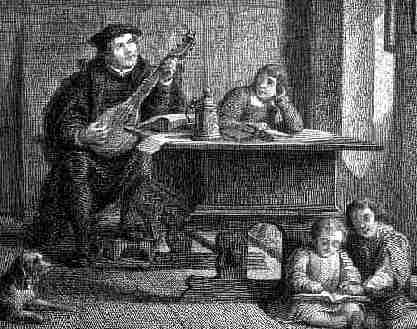
By the way, I love that picture of Luther because it reminds me of myself...sitting at the table with my instrument, a drink on the table, papers scattered, children playing in the room, dog on the floor...that table even looks like mine.