Showing posts with label gloriously unnecessary. Show all posts

Friday, July 25, 2014

Directions for Singing: Part 3a - Sing All

The third direction John Wesley gives us is like a shotgun blast. His aim hits the target, but does so in a way that covers a lot of ground. I initially intended to give my thoughts on this entire point in one go, but I happened upon a few interesting rabbit trails along the way and allowed myself to meander. 

3. Sing All. See that you join with the congregation as frequently as you can. Let not a slight degree of weakness or weariness hinder you. If it is a cross to you, take it up and you will find a blessing.

Today I’d like to look at the first sentence: Sing All.

When I read “Sing All” I am immediately aware of three possible meanings: 1) Sing all of the hymns in the hymnbook. 2) Sing all of the words in the hymn. 3) Sing all, every one of you. Wesley may have intended it to mean only one of them, but since we cannot ask him (for he’s been dead for over two centuries) and since I think all of the meanings I’ve gathered from these two words would be agreeable to Wesley anyway, I’ll go for it.

Sing All of the Hymns in the Hymnbook
Sing every song. Every one of them. The whole shebang. Even that one. Allow me to backup before I run and jump into this. Singing all the hymns from the hymnbook is almost a foreign concept to our PowerPoint-shaped minds. Technology today gives us the ability to sing a 400 year old song and a song written 2 hours ago in the very same service without even a hitch. Even if you don’t have access to a projector, most have access to a printer that will meet your immediate needs (Gutenberg would be so proud). The way we view the hymnal today is vastly different from how it was viewed back then. Don’t miss the importance of this. In the past, the hymnal was more or less a requirement. Today the hymnal is optional. One could think of the physical hymn book as a well, and projected (or print-on-demand) lyrics as a faucet.

"Spring up, O well! sweet fountain, spring!"
In many ways the ‘worship wars’ transition of the recent past could be boiled down to how people viewed the physical hymn book. Folks who were used to the well, sustained by the well, whose lifestyle developed around the use of the well, were suddenly introduced to this newfangled doohickey called the faucet. No longer did one have to go outside to the well for water, you could just flip it on in the house. When they went to the well they knew exactly where their water was coming from. But this new plumbing brought water to the faucet from somewhere else. Surely there must be a reservoir somewhere, but how do we know where it came from? How can we be sure someone hasn’t put something else in it? Besides, this tap water tastes funny.

"Pour out your power and love"
Do you see what happened? Nothing essentially negative has occurred. But something negative might occur. And it certainly changes the rhythm of how life used to be. Something solid and reliable has been removed. The hymn book, for centuries has been a haven. A place of solace. Between these two covers is sustenance and safety. If you take a look back at the preface of hymnals such as those developed by pastors like Gadsby and Spurgeon, you will see that one of their concerns is to have a body of songs that have been vetted and approved and are ready for consumption. This is more or less the same reason there is a different hymnal for every denomination. For the good of their people they tailored their hymnbooks to gather the good stuff and avoid the junk.

Along comes technology and it allowed immediate access to new and different songs. The well water that is good for drinking, the one our fathers’ fathers have been drinking from for all these years, is suddenly unnecessary. Now, only pragmatists wish to destroy that which is unnecessary, and believe you me the modern church is chalk full of pragmatists. And because the modern church is chalk full of pragmatists that means they lined up on both sides. The Hymnbooker Pragmatists were of the opinion that the Projector and the music it brought with it were unnecessary in light of what they already had. The PowerPointer Pragmatists stood firm in their belief that the hymnbook was impractical in light of what they now had. Are you starting to hear the war drums beat? (Well…at least one side was pounding drums…) Meanwhile those Christians who hadn’t succumbed to the temptations of the goddess, Pragma, were taking part in a revolutionary concept in our day in age; they were singing together. For Christians are the best at reveling in that which is gloriously unnecessary.

Well that’s enough backing up, now for the run and jump. All of that was said so that we can see the reason John Wesley directed his people to “Sing All” was because this Hymnbook was the Well he dug and he knew it was good. Like Spurgeon and Gadsby after him, Wesley developed this hymnbook for sustenance and safety. Every song was included for a reason; to glorify God and to edify the Church. He wanted his people to draw deep and drink all the well had to offer.

Sing All of the Words in the Hymn
Growing up I figured there must’ve been some Baptist rule in hymn singing that went like this: “You Shall Sing Verses 1, 2, and 4. Never Verse 3.” Is it me or did they always skip verse 3? Perhaps the third verse was the Baptist version of diabolus in musica? Whatever the reason, skipping verses in this way conveyed to me, even at a young age, a pretty strong message: The length of the song trumps the content of the song. This, in turn, conveyed the idea that singing didn’t matter much. It was just something we do because it’s something we’ve always done. Get on with it. And if singing didn’t matter much, what we sang didn’t matter much. And if what we sang didn’t matter much, well then; songs to and about our Creator and Savior that don’t matter to Christians are the devil’s favorite tunes.

That said, skipping verses is not a bad thing. Sometimes it is appropriate and necessary. Sometimes singing one verse is enough. But this shouldn’t be the rule or arbitrary habit in gathered worship and I think John Wesley would agree. Skipping verses in singing is like skipping verses of Scripture. Imagine someone reading Scripture during worship and always skipping every third verse. You might get the point across but really you are betraying the context and the content. A hymn is more likely to build upon itself than our modern verse/chorus/verse/chorus songs. More often, hymns, like a puzzle, require each piece to see the whole picture. But in the end wisdom and discernment should prevail. If you as a leader, or you as a singer, choose to omit a word or a verse then it ought not be arbitrary or done without thinking.

Sing All, Every One of You
Out of all of the meanings I’ve pulled out of “Sing All”, I feel like this one likely hits closest to Wesley’s intention. The emphasis he places on “All” with italics causes me to want to interpret “All” as “Everybody”. And the immediate “see that you join with the congregation” also leads me there. Whatever his intention, this is good advice.

I would that you might suffer me another ‘growin up Baptist’ anecdote. I mentioned how skipping the third verse caused me to slide down a slope of Doesn’t Matter Much of Whatcha Sing. So it comes as no surprise that there were many mouths clamped shut during our times of singing. Singing was (is!) a burden to many. I grew up in a church full of lackluster singing. But I never knew how bad it was until I attended another congregation. The song was “Praise to the Lord, the Almighty” and before I uttered two melodic syllables I was struck dumb. I stopped singing because I was amazed at the sound around me. The voice of the congregation boomed. I checked the ceiling to make sure it was still intact. I looked around me to make sure the heavenly host hadn’t joined in. And there was one more thing that took me a moment to pin down. What was that sound? That deep rumble. That punch. That sound that invigorated and fortified my soul. It was the sound of men singing. I mean, really singing. It was an experience I’ll never forget. The following week found me again at First Baptist Church of Dreary Song and as we stood to sing verses 1, 2 and 4, my soul was dismayed. No wonder Wesley encouraged everyone to sing.


We’ll dig a bit more into this in the next installment.

============
Previous installments of the Direction's for Singing series

Monday, March 18, 2013

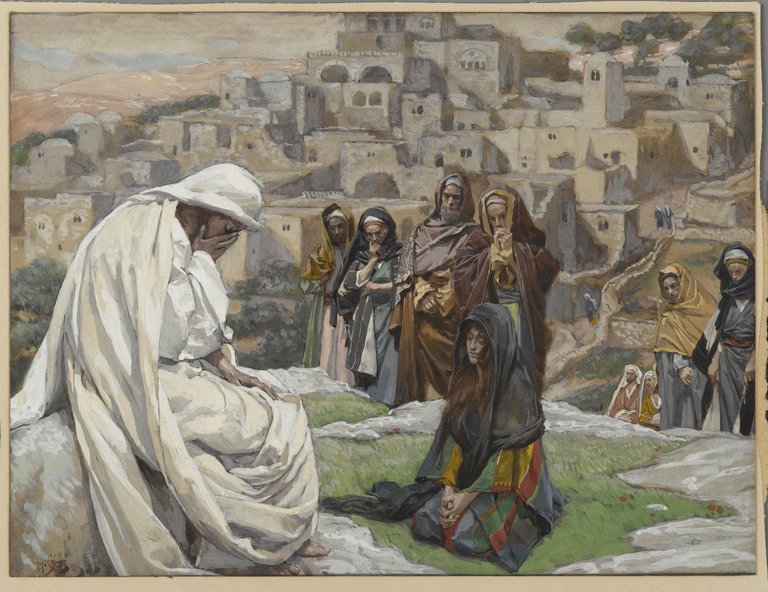
Jesus Wept (Because He's Not a Pragmatist)

Take a gander through John 11.

Why did Jesus weep? Not cry. Not sniffle. Weep. Hopefully, the question seems odd. His friend died, why wouldn’t he weep, right? But then again, Jesus knew he would raise Lazarus up from the dead. So we ponder, if Jesus knew he was going to raise Lazarus, why did he weep?

This was the question proposed in the sermon this past Sunday, a worthy and accurate account of why Jesus wept. I will link to it when the audio is up. But as this question was posed my mind was wandering. There are many possible answers as to why he wept, but I think an important reason is that Jesus wept because he’s not a pragmatist.

A pragmatist looks at this situation and believes there is nothing to weep over. A pragmatist believes the ends justify the means and so Christ’s weeping before raising Lazarus doesn’t compute. At first glance it doesn’t appear that we view this through pragmatic lenses, but that is because we’re not dealing with a moral issue. It’s easy to spot and criticize pragmatism when evil is used as a path to do good. It’s harder to see it when we’re dealing with the practicality and usefulness of things.

A pragmatist looks at Jesus weeping and sees it as unnecessary. There is no reason why he should be weeping since the very cause of his weeping will be made right by himself in only a few moments. But Jesus, fully knowing that Lazarus will soon rise, still weeps.

The pragmatist simply is unable to come to terms with the fact that Jesus wept simply because he was sad. Twice Jesus was “deeply moved” says John. Jesus doesn’t put the cart before the horse. A man, his friend whom he loved, has died. Lazarus’ sisters, even in their belief in Jesus, are grieving and Jesus resonates with their grief. Something unnatural to the created order has taken place. Death. It’s wrong. And Jesus appropriately responds. Death is heavy, weighty, worth lingering over, even with the knowledge that it will one day be reversed. Jesus lingers over this. Takes the time to weep. The pragmatist is astonished at this. Why waste tears and sobs? Why not snap your fingers and get it over with?

If a pragmatist watching from the sidelines were to ask Jesus about it afterwards, here’s how I think it would’ve gone down:

Pragmatist: If you could raise him from the dead, why did you weep?
Jesus: Because he died and he was my friend and I love him and his sisters.
Pragmatist: No doubt you loved him, but why cry when you knew he’d come alive again?
Jesus: Because he died.
Pragmatist: Of course, but you knew he’d live again.
Jesus: And so will you.
Pragmatist: Sure, sure. Resurrection at the Last Day and stuff. But you knew beforehand that you would raise him from the dead. Your disciples told me that the very reason you came was to “go to awaken him”. You had this planned from before you came. You knew he died when you were far off, and the reason you came was to awaken him. But you still shed tears? Why?
Jesus: Because he died and he was my friend and I love him and his sisters.

If the pragmatist didn’t keep pestering, I’m sure he would’ve thrown up his hands in frustration and walked away.

There is no room for pragmatism in the slightest. Pragmatism demands an answer here that cannot be given because it will always be the wrong answer. Jesus wept because his friend died. Because he saw how much it grieved the sisters. Because death is wrong and weeping in the face of death is right and appropriate. Instead of snapping his fingers and getting the job done Jesus took the time to weep.

Why is it important for us to realize that Jesus’ weeping was a result of him not being a pragmatist? It’s important because there’s a heck-of-a-lot of pragmatists who follow Jesus and for some reason it seems most of them find their way into the ministry. It’s good to notice this because it forces us to realize that pragmatism is antithetic to the way Jesus operated. It’s good for us to see that pragmatism fails even when it’s disconnected from moral issues. A pragmatist sees Jesus’ weeping as unnecessary.

Ministers and pastors and church planters and leadership coaches and whoever else with their fingers in the pie ought to cling to this. Jesus doesn’t operate from a strategic pragmatic position. You’re not going to find a formulaic system you can pull from Scripture to discover the “Jesus Method” and if you do it’s because you’ve already spilled your pragmatic Kool-Aid all over the text. The only way to emulate Jesus is to suffer and die. Deny yourself and take up your cross and all that. That’s the proven track record and, surprise, it’s not pragmatic in the least.

This all sounds good. Pragmatism, boo! Take up your cross, yay! That is, until we get to the church budget, right? It tends to throw a monkey wrench into our leadership goals and ‘vision casting’, doesn’t it? Hopefully it causes us to look at things like grace a bit longer. How many scandals would strike the church if we took grace as seriously as Christ did, and not limit grace to only those who qualify for it under our pragmatic goals? We show love to victims of crime. Do we show love to criminals? Do we love people or do we love a demographic? I could go on. The implications of Jesus weeping are huge.

Friday, July 6, 2012

The Gloriously Unnecessary: Stars

When Man deems, in his own estimation, that a thing is no longer practical, necessary, or convenient he will, at all costs, do his best to rid the world of it.

Evidence for this can be seen in the continual assault on the stars. Of course, no one is intentionally (as far as I can tell) trying to blot out the starry sky, but it is an assault nonetheless because Man has deemed that stars are no longer practical. What purpose do they serve for our ever increasing techno-industrialized society? We no longer need the stars for navigation; there are all manner of gadgets at our disposal for that (maps, GPS, etc). Stars are of no use as a source of light. Street lamps now light the way.

At one time the stars were heralds proclaiming the glory of God. At their haughtiest they were even considered gods. Legends are the stuff of stars. But science has demystified all of that hasn’t it? The ancients wrapped the stars in a cloak of mythology. Tales of epic proportions came from the sky. Now nerds in white coats drone on about “dead light” and balls of gas and in the name of discovery and advancement have achieved a greater evil than any primal pagan; they have stripped the sky of Awe. Though the pagan was wrong in worshipping the stars, he was more right than the scientist. At least when the pagan looked up his breath was taken away. Modern Man yawns, or squints, since he’s been raised in a land that attempts to wash away the starry host, night after night, with all of the practical, necessary, and convenient things like street lamps, billboards, and sky scrapers.  C.S. Lewis was on to something when he condemned modern man for rejecting the word “heavens” and replacing it with “space”.

But to say that an impractical thing is good doesn’t mean that the practical thing that replaced it is bad. In fact, our practical inventions like navigation systems have freed the stars from their ignoble task of “directions”. If stars are only viewed as “directions” then they are being enslaved to practicalism (rather than assaulted as an enemy as they are now; when the beast is no longer useful, put it out of its misery). I for one, prefer Mapquest over the stars. However, just because a practical invention negates the use of stars in a particular way, rendering it “unnecessary” does not mean Man should war against it (though he will). Stars are unnecessary to Modern Man, but they are gloriously unnecessary.

In this sense the stars have been liberated, set free from their task masters. They have been released from bondage and precisely because they are unnecessary to Modern Man, they are now in the greatest position to fulfill their God-given mission; to proclaim the glory of God. And now that the stars have regained their rightful place, Man’s assault on the stars is all the more telling. The attempt to blot out the heavenly bodies is really an attempt to blot out the Heavenly altogether. The stars are screaming out the beauty, the glory, and the wonder of God and in response Man is holding his ears firmly shut shouting, “I can’t hear you!” So the faint, seldom seen stars glimpsed above the city lights pronounce “Woe!” (which is still the glory of God).

I work in the city and live in the country. Each night after work around eleven o’clock, as I’m heading to my car I look up and see a dark hazy sky, tinged with yellow city lights. One or two stars have been crafty enough to shine through. As I make the journey home the sky gradually begins to expand and grow darker. And mile after mile the stars multiply and shine brighter. Somewhere at the tail-end of the suburbs, just a few miles past the electric madness of the car dealerships, I take a right and the sky explodes. The trek from urban to rural is a cosmic experience.

The Gloriously Unnecessary has just punched me in the gut and sucked the air from my lungs. I’m forced to look up. I have no choice. I’ve even pulled the car over just to look. The jungle of street lamps and illumined advertisements I just drove through cannot rightly be called ‘light’ anymore. They’re cheap knockoffs. They point me in the wrong direction. They point me to the glory of Man. The stars, though—the rightful light—have drawn me in. As they led the ancient ships in ages past they will not fail in pointing me in the right direction. They point me to the glory of God. It is in moments such as this when Man tastes that which is truly necessary.