Showing posts with label hymn writing. Show all posts

Wednesday, July 23, 2014

Directions for Singing: Part 2 - Sing Them Exactly

Today we continue looking at John Wesley’s “Direction’s for Singing” with his second point,

2. Sing them exactly as they are printed here, without altering or mending them at all; and if you have learned to sing them otherwise, unlearn it as soon as you can.

This point is an overflow from point 1. There we saw how Wesley wanted to build a foundation based on sound doctrine and create a formative tradition. Point 2 indicates that Wesley was concerned with the purity of what he was feeding his people. His initial point, “Learn only these songs first” was important because the songs had something particular he wanted taught. But if the songs are changed or had been learned in a different way, then it just might act as a monkey wrench and disrupt both doctrine and fellowship.

In the previous post I spoke of the people having a common language through these hymns. But if some had learned a song in a different way or if some chose to alter the words printed, then that common language is in danger of being lost. And more importantly, the purity of the doctrine that was laid down originally, if altered, may lead to division within the body over doctrine.

So we see that Direction 2 serves to preserve the goal in Direction 1.

I find myself a bit on both sides of the fence on this, but I largely find myself sympathetic to Wesley’s line of thinking. On one hand I am a huge proponent of clarity in worship. I imagine a 300 year old hymn, full of rich truth and beauty, but it also contains words or phrases that are essentially meaningless and/or confusing to the common parishioner. I believe that someone with deft hand with a pastoral heart may take that hymn and alter it, without changing the content or context of the hymn. Thees and Thous come to many minds, but some words like fetter or Ebeneezer cause many to pause and say, “raise my what!?” The phrase “contracted to a span” while beautifully crafted, may not convey a lick of the Incarnation to some congregations. And don’t get me started on the yearning of our bowels.

So I really do believe it is okay in some ways to alter words or phrases when done with skill and a heart to make things clear for the worshippers of God. Even when it goes beyond language and overlaps into doctrine, I still think there is a time and place to alter words. Emphases on certain doctrines change throughout the centuries and so it is conceivable that there might be a phrase that was appropriate for sound doctrine in days past that may not be fully understood as sound in our day. In our aim for clarity we need to be wise, discerning, and respectful of the hymn writer’s art.
John Wesley would not be pleased

With that said, I tend to side with Wesley on the whole. I believe Wesley was aiming at keeping pure the doctrine contained in the hymns. If alterations are made, not simply for clarity, but to change the context or content of the song, especially to make it mean something other than it intended, then the hymn has been hijacked and ruined. While there are likely exceptions, it’s probably better to drop the hymn than to give it a Total Hymn Makeover. It is one thing to patiently restore a masterpiece painting, slowly revealing and touching up that which has faded. It is quite another to superimpose or erase content so that you and your followers feel better about it.

Here’s a good example. A couple years ago in Spain a woman attempted to restore a beautiful but worn and faded fresco of Jesus. It turned out bad. Like a-train-loaded-with-explosives-running-headlong-into-the-middle-of-a-nitroglycerin-factory-next-door-to-a-nuclear-plant bad.
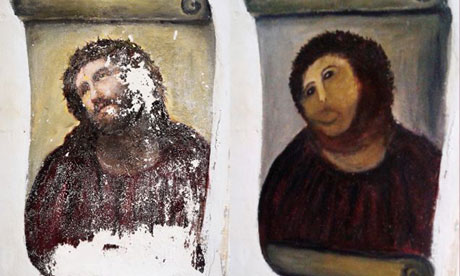
umm...don't do this to your hymns...

Here’s a more appropriate example, and it’s one that I think really gets to the heart of Wesley’s concern. Recently the song “In Christ Alone” by Keith Getty and Stuart Townend made national news when the song was ultimately rejected to be included in a new hymnal for the Presbyterian Church (USA). The reason it was rejected was because the songwriters pulled a John Wesley and refused to allow one of their lyrics changed. The lyric in question is originally written as,

Till on that cross as Jesus died
The wrath of God was satisfied

The hymn committee wanted to change the lyric to read,

Till on that cross as Jesus died
The love of God was magnified

It was a close decision but ultimately, after Getty and Townend refused to allow their lyrics to be changed, the committee voted to drop the song from their hymnbook. This sparked a firestorm of blogs and news outlets that centered on the doctrine of atonement. All because of one line, and some say one word, in a hymn. I think this example alone is enough evidence to justify Wesley’s second point.

============
Previous installments of the Direction's for Singing series

Friday, October 28, 2011

My Heart is Black and Wicked

October 31st is Reformation Day and usually the Sunday before many churches will celebrate Reformation Sunday. At our church we mainly celebrate this day through song. After all, it was because of the Reformation that we have such a rich history of congregational singing.

If we don't sing a song that was sung during the Reformation, such as "A Mighty Fortress is Our God" or "All People that on Earth Do Dwell", we will sing songs that reflect the spirit of the Reformation, such as "How Firm a Foundation".

Another song we will be singing this Sunday is a song I wrote a few years ago that I always thought appropriate for Reformation Sunday, but until now I have never really been happy with any melody I've put to it. Over the last week or so I've been able to work with this song again and am happy to be able to sing it with the church as we gather together this Sunday. I'm also happy to be able to share it with you as well! Hope you are blessed by it and have a great Reformation Sunday!

My Heart is Black and Wicked by Rich Tuttle

My Heart is Black and Wicked

My heart is black and wicked Lord, it never will obey
Your Holy wrath for me is stored, eternal - day by day
Against Infinite Perfectness we offer perfect sin
Our punishment, eternally, is death and death again

Upon the tree of sin and death, a curse for all to see
"Tis finished!" is His dying breath; His blood has ransomed me
Atonement made for those He chose; God's wrath is satisfied
His punishment becomes our peace and we are justified

By grace alone through faith alone, His gospel we believe
This faith which rests in Christ alone, He gives and we receive
And by the Word of God alone this gospel we proclaim
All glory be to God alone! O praise His Holy Name!

Friday, September 23, 2011

Wanted: Hymn Writers

The church is always in need of more hymns. Good hymns. Hymns that last the test of time. Hymns busting at the seams with biblical truth matched with mind blowing beauty. Hymns full of sound doxology. A robust collection of hymns that give voice to every occasion.

One thing the church does not need more of is bad hymns. Shallow hymns. Ugly hymns. Meaningless hymns. Unfortunately it is much easier to write wretchedly than it is to write wonderfully.

So what the church needs (and always needs) is an army of hymn writers. Hymn writers who value truth and beauty. Hymn writers that venture into the depths of the riches of the wisdom and the knowledge of God and come back with treasures and tales of their adventures in that marvelous, perilous realm. What a noble task it is for the church to equip their poet-warriors with the necessary tools and training for such a calling.

Unfortunately, the church in America has done a pretty pitiful job at raising up hymn writers. I mean, if the church struggles to raise up pastors, how on earth will they be able to raise up hymn writers? I'm not talking about training and equipping musicians, though I believe that is a worthy goal I also believe that the church has more musicians than she knows what to do with. Heaven knows we could certainly deal with one less rock star wannabe. Then again, Heaven knows we could certainly benefit from fresh new melodies packed with submissive beauty.

But hymn writers need to be more than musicians. I would even say it is possible that one does not necessarily even need to be musically talented to be a good hymn writer. Though musicality is beneficial, I would argue that hymn writers need to be poetical rather than musical (though some would argue they are one in the same to some degree). But the point is that a hymn writer doesn't need to play piano or guitar or even sing well to write a good hymn.

Not only does one need to be poetical, but also vastly knowledgeable about God. This means that an understanding of sound theology and doctrine is crucial for the hymn writer. It is no surprise to me to see that almost every master hymn writer in the past was a pastor. Wesley, Watts, Newton, Doddridge, etc. Their main business was mining the depths of the gospel each week. To do so they had to be intimate with the Scriptures. As a result, not only were these men pastors worthy of emulation, they became the greatest hymn writers of the English language. Where are our pastor-hymn writers of today? There are exceptions to this however, in that there are many great hymn writers who were laymen. Anne Steele and William Cowper, for example. But only skim through their hymns and you will find that they are dripping with theology like honey from the comb.

The key is that a hymn writer needs to strive to become masterful in joining together truth with beauty. (A love for the people of God, I believe is quite necessary as well.) I like how Kevin Twit describes this melding of truth and beauty in hymns: "theology on fire". And it's in the church's best intrest to invest time, energy, and resources into developing and assisting her hymn writers.

Most of these thoughts were fueled by the following three articles. I happened to read them all within about a day of each other and I became greatly encouraged how each one seeks to support the hymn writer.

Here’s a portion of what he says:
"Let this be an encouragement to modern hymn writers—a cause for inspiration to those who are suffering from writer’s block. There are so many Biblical scenes to choose from that would make for beautiful songs: the transfiguration of Christ, the feeding of the five thousand, the woman at the well, the stoning of Stephen, water baptism, washing of the disciple’s feet, the betrayal of Judas. If just a few good modern hymn writers tackled some of these subjects, the anguish that untold thousands of music ministers suffer weekly could be greatly diminished.

It’s easy to write a chorus that says:
God, you are a Holy God
I need your grace to see me through
I need your mercy to make me new
Let me live each day for you.

I just made that up in two minutes and there’s nothing wrong with it. It might fit easily and competitively among the hundreds of worship songs that are available to choose from. But compare those lines to the third stanza from the above hymn:

Let holy charity mine outward vesture be,
And lowliness become mine inner clothing;
True lowliness of heart, which takes the humbler part,
And o’er its own shortcomings weeps with loathing.

It took some real thought to craft those lines. They’re timeless. They set a standard for all of us who write music for the church. I didn’t set out to write a didactic piece. I’m reminding myself, too. Be specific when you write songs about God. Avoid cliché. Avoid convenience. Avoid an obsession with the consumer. Avoid the temptation to make commercial success your central goal. Write with intelligence, employing all the craft, skill, and experience with which God has endowed you."
I absolutely love what he has to say. Though this kind of thing has been said before, it can never be said enough. Encouragement and advice like this needs to become as strong and steady as a pounding drum.

  • The second article that caught my eye is over at Cardiphonia. Bruce Benedict has been kind enough to share what he's been learning in his "Songwriting and Theology" class at Duke. I hope he takes good notes because I'm stealing them...
Songwriting and Theology
Songwriting and Theology Week 2 Paradoxes 

These posts are great in and of themselves and Bruce links to some great thought provoking articles, but what really grabbed my attention was something his teacher said:
"The Church has no theological expectations of her musicians."
This such a sad statement that at first I had a hard time agreeing with it. But after thinking about it and pondering the putrid wasteland of music that has been produced (and peddled, and packaged, and sold)  by the American Church, I have to agree for the most part. It is certainly true that this is an accurate reflection of the status quo.

I would also take that expression and turn it on it's head a bit and say that, "The Church has no poetical or musical expectations of her pastors and theologians."

  • Third, I came across this new blog by Sojourn Music songwriters Bobby and Kristen Gilles called My Song in the Night. It looks as if this entire blog will be highly beneficial the hymn writer.
The 'mission statement' of the blog says this:
"Helping you express words of worship and testimony through songs and stories."
The article I specifically want to direct your attention to is one in their Songwriting section called Modern Hymns. They do an excellent job at laying out a very basic outline of the ins and outs of hymn writing. Just reading through this made me want to stop and find a pen and paper.


  • Lastly, though I didn't just run across this, I do want to direct your attention to a post I put up a few years back called Towards a Better Hymnody. I link to a pamphlet that I think will continue to help us think soundly about our hymnody and our hymn writers. Also, as it was written more than 50 years ago, it lends to the idea that the church is always looking for better hymns and hymn writers.

I hope that these articles have motivated you like they have me. Let's keep the drum pounding. Let's keep spreading the word that the church is in great need of hymn writers.