NOTE: The following is long. And unfortunately, in my opinion, it fails in some regards as to my actual feelings concerning Christian radio and it’s affect on worship music. It may come off as paradoxical at times, without adequate explanation. It is my hope that if you come away with questions that you would either post your thoughts in the comment section below or email me at sounddoxology@gmail.com. There is little doubt that I will be addressing many of the topics presented, piece by piece, throughout the lifetime of this blog. Ok, done. Read on! Part I
 was my lighthearted attempt to introduce this topic. Here in Part II, I want to get into what really upsets me about Christian radio.
The real problem I have with Christian radio is that Christian radio stations make no distinction between songs composed by Christian artists as art and songs composed for the church to sing during worship. This problem runs so deep that people are shocked to find out that there really is a difference. This is because Christian radio and the “worship” industry have not only blurred the lines, they have obliterated them. To be clear, I am not posting this to slam Christian music. I love Christian music and respect musicians and songwriters who are Christians. Some of the greatest music in the world has been written by Christians. My point here is to show that there is a distinction between a song appropriate for worship and a song produced by a Christian artist for entertainment, or even "ministry." I am going to attempt to explain why I feel this is a problem, how it negatively affects the church, and where we go from there.
Reason #1: By placing songs not written for congregational worship alongside songs that are leads to a tendency for people to believe that every song on Christian radio is suitable for gathered worship on Sunday morning. This can be a fine line to walk, especially when an artist finds success at writing songs suitable for a congregation as well as writing songs for entertainment. There is a major difference between a Christian who creates music as an expression of himself/herself or for entertainment or to pursue a career in pop-music and a Christian who purposely composes a song to be utilized in a corporate worship setting. While the “worship music” industry might be blamed for pumping out the next Christian Britney Spears, Christian radio is to blame for presenting that artists music as if it were suitable for the congregation during worship. And to be sure, we are to blame for our lack of discernment in this area.
Reason #2: While many people are edified and utilize Christian radio to individually worship God, the overarching aim of Christian radio is entertainment. Thus, when worship songs are played, entertainment automatically becomes its purpose—intentionally or not. Entertainment is not a bad thing. But worship songs are not intended to be entertainment; they are intended to facilitate believers to praise God through song.
How does this negatively affect music for worship in the church? Well to begin answering that question I think we need to first answer another one: What makes a song suitable or not suitable for congregational worship? For the most part, my blog is dedicated to distinguishing between the two and it would take a lot more room for me to cover that subject exhaustively here, and would detract from this current topic, so I’ll try to be brief. What makes this question difficult is that most, if not all, of the music played on Christian radio glorifies God and can help people worship God. But what I am speaking about here is the actual worship service itself. I’m not talking about private worship, but corporate worship as laid out in Scripture. And here’s the difference (and a shocker to some); what we do individually to worship God does not necessarily translate as worship in a corporate setting.
For example, a surgeon may glorify God through his vocation by using his skills to save a life, and he may cause others to worship God because they are thankful that God has saved their loved one, but it wouldn’t be appropriate to build and ER in the Sanctuary, or for the doctor to perform surgeries on the altar. My point is that a song written with the congregation in mind will tend to focus more on objective truth rather than subjective experience. That surgeon, if allowed to operate on the altar, though glorifying God in his own way, does not lend to the building up of the body during the worship service. His experience is very subjective. How is the guy five pews back glorifying God through the surgeons actions? And that’s just one example. Why should it be any different with songs?
The most difficult part about discerning which songs are appropriate and which songs are not is that, for the most part, I cannot list them to you here. What I may feel is appropriate for my congregation may not be what is appropriate for yours. For instance, Bob Kauflin gives an example in his book "Worship Matters" about how he doesn't lead his congregation in singing the song “Above All” because there are people in his congregation who might misinterpret what the song is saying. The last line, “You took the fall and thought of me above all” can be a glorious reality for a believer, but a person can also read into that line that “I” am the most important thing in the universe. What is more, when we sing of Jesus taking “the fall” it implies a small amount of irreverence because what Jesus has done can hardly be described as “taking the fall.” The brother, who takes the blame for stealing a gumball when in fact it was his sister, takes the fall. The event of Christ taking on our sin and the Holy wrath of God, in my opinion, can hardly be described as “taking the fall.” But that being said, in another congregation these issues may not be a problem and the song is discerned to be just fine.
But the bigger (and perhaps my main) problem is that the radio has given rise to a lot of worship songs that are extremely shallow and vague. The reason many new worship songs become so popular on the radio is the very same reason any other song becomes popular on the radio; it has a good, catchy tune that is repetitive and simple with a general theme. There is a reason why songs on the radio don’t have more than two verses. There is a reason why “hit worship songs” steer clear of
specific theology. Because it is music for the masses; and perhaps therein is where the root of our problem lies.
Let's take a look at a common scenario: T.V. networks will cancel a show, despite the 2 million viewers who love the show, if they can produce something that will appeal to a much broader audience that will bring in more ratings and thus, more money. It doesn’t matter to them if the show was well written or if the show brought satisfaction to those who watched it. What are 2 million viewers compared to 20 million? So they create a show that appeals to everyone and that means that they must do something simple, catchy, and familiar. Quality and authenticity are sacrificed or at best become secondary. As far as I can tell, this is the same mentality that operates within the “worship music” industry and Christian radio is more than happy to take it and run with it. And in turn, we are more than happy to take it at face value, never discerning anything labeled “Christian” while ignorance runs rampant in our churches.
The culture has crept in among many areas of the Church but nowhere else has the culture so greatly impacted the Church than in her consumption and replication of her music. This isn’t about “good music” vs. “bad music” as much as it is about Worship vs. Entertainment--or at least an Entertainment Mentality. This isn’t about style either. Having a soloist, or a rock band, or a pianist, or a choir lead worship isn’t wrong, nor is it the issue, but those who lead and those who are led must continually check their motivations and reasons for the music that is selected and sung. I cringe when I hear someone talking about going to worship to hear the “awesome band.” We go to concerts to hear an awesome band; we go to worship to worship God. I’m not saying the praise band has to suck, in fact that should never be the case. Musicians who lead worship should constantly strive for musical excellence. But it really is time for us to stop being duped into popular music for popular music’s sake, as if popular music is the only resource available for American Christians.
The hardest part about all of this is that many of the people involved in the “worship” industry and Christian radio are really good people who strive to glorify Christ in their vocation, be that a radio DJ, a record label president, an artist, or even the worship leader who “made it big.” So how do we handle this and what are we to do about it? Do we throw our radios out of the window? No. Do we boycott our local radio stations? No, that would be ridiculous. So how do we counter this? Maybe the question ought to be, Should we even counter this? And more and more I keep coming to the conclusion that perhaps we should just accept it for what it is, and for the most part it is music produced for a mass audience for profit. The best thing we can do is just to be aware and more discerning.
For as much as I rail on the “worship” industry, I am seeing signs of change. I am seeing more of a division between entertainment music and music for worship. But as it stands, Christian radio continues to make no such distinction.
Perhaps where I am most encouraged is through the internet. There are projects starting from the ground up, rather than from the top down, and they are being recognized for producing good quality, authentic music fit for congregational worship. And instead of being pandered for profit, these songs are moving by word of mouth through church services, conferences, and ultimately the internet. Groups, not limited to, but including
Indelible Grace,
Sovereign Grace Music, and
Sojourn Music have for the most part songs written and composed by the church for the church. And not only do these groups create songs for worship, but most of them provide sheet music of their songs for free, which is an extremely beneficial resource for music ministers.
This is where I see the future (and oddly enough, the past) of worship music; songs written
by the church
for the church and offered at a relatively low price to
serve the church. And not only do I see this as the future of worship music, but this is an area where I see Christians shaping the culture of music. Already, the “worship” industry, alongside the other Big Music Industries are being hit financially as they are finding out that it is becoming harder and harder to maintain their model of business in an internet age.
As for the future of Christian radio, I think it will continue, and I am glad. But I don’t believe a distinction between worship and entertainment will be offered any time soon, which is sad, but it means that we must be ever more vigilant and diligent to
rightly discern what to select and sing during congregational worship.

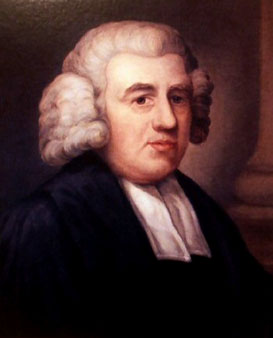 Well how about that. Isaac Watts last week and John Newton this week. I think it's really cool having my birthday bookended by these great pastor/hymnwriters. As most people know John Newton wrote that great hymn "Amazing Grace". It has been said that "Amazing Grace" is America's best loved song of all time.